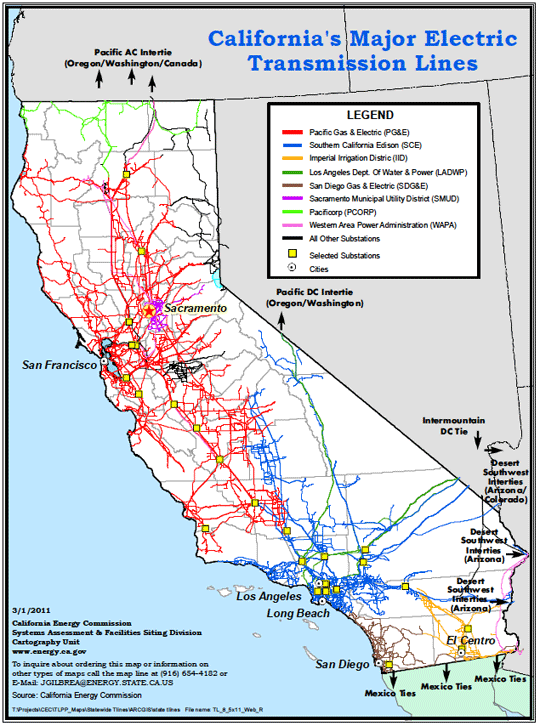
It's absolutely crazy reading about these events happening in a first world country in the richest state in that country. Something has gone seriously wrong when we're seeing near-daily stories about power outages in the tech capital of the world. Combined with all the other issues plaguing CA right now, I can't see why companies still base themselves there. Eventually the "all the tech people are there" argument won't be strong enough and competing markets like NYC, Seattle, and Austin will win out.
In many parts of the world, power is unreliable due to a lack of resources -- fuel, capital, labour, distribution, maintenance. Power cuts occur, either scheduled or unscheduled, due to an inability to meet demand.
The case in California is different. The fundamental resources are present: there is fuel (or, in many cases, hydroelectric, geothermal, nuclear, wind, or solar power) for generation. Distribution systems exist. There is no shortage of local labour. Systems aren't going offline due to direct failures of maintenance.
Rather: the outages are prompted by a consequence risk. Given the extreme fire danger throughout the state, the least source of ignition creates a fire hazard, and electrical transmission and distribution equipment is a high risk for such ignition.
Previous major wildfires have been sparked by: mower blades, rims of flat tires sparking on pavement, catalytic converters parked over dry grass, sparks from a hammer. And electrical equipment.
There's a case to be made that PG&E have neglected maintenance activies not related directly to continued operation of their plant, but to risk mitigation, and I'm not going to argue one way or the other.
But the fundamental problem California's electric utilities face is not that of most of the world, where means are insufficient, but that consequence is too great to ignore. I'm coming to see this generally as a late-stage dynamic in many technological areas, one in which the unintended consequences (sometimes unanticipated, often not) simply rise to a level of major significance. You might think of these generally as hygiene factors (the phrase I've been using).
Past examples would include:
- Basic personal and public hygiene factors for maintaining public health in cities.
- Pollution control laws affecting solid, liquid, and gas emissions of activities and plants.
- Environmental contamination as with lead, asbestos, pesticides, tobacco, sulfur dioxide ("acid rain"), and CO2.
- Individual psychological and widespread sociological negative impacts of information overload, media saturation and manipulation, and computer systems overexposure.
- Running extensive high-capacity electrical distribution systems through increasingly fire-prone landscapes.
Or put another way: this is increasingly our future.
"Previous major wildfires have been sparked by: mower blades, rims of flat tires sparking on pavement, catalytic converters parked over dry grass, sparks from a hammer. And electrical equipment."
Honestly, at that point, you have a fire, it's just not burning yet. The idea that we can prevent fires from happening by preventing all sources of ignition in hundreds and hundreds of square miles is completely absurd. Even though Man is responsible for a lot of ignition, he's not responsible for all of them. Even if you completely removed civilization, it's still going to be a fire.
I don't have a solution, or any good news here. Best thing I can think of at this point is spending a shit ton of money and creating some very large fire breaks around cities and then burning on purpose, but California probably can't do that either. By the time the eminent domain lawsuits and counterlawsuits happened, the environmental review happens ("we plan on killing lots of things, and then we're going to set the rest of the stuff we didn't kill on fire" isn't exactly going to sail through the review process), and everyone gets their beaks wetted, it'll just end up being a giant waste of money that gets ended with the fires occur anyhow. And the fire breaks would have to be huge; we're probably measuring the necessary widths with miles fairly reasonably. (Possibly <1 mile, but certainly multiple tenths of a mile.) And the liability. Nobody sane would take that job.
"Even though Man is responsible for a lot of ignition, he's not responsible for all of them. Even if you completely removed civilization, it's still going to be a fire."
Actually, other than a one-in-a-billion naturally occurring compost pile that, by chance, falls into place and reaches burning temperature, internally, the only natural source of wildland fire ignition is lightning.
Which is interesting because in many parts of coastal Marin/Sonoma/Mendocino/Napa counties, there is, essentially, no lightning. I have lived in Marin for ten years and have seen lightning exactly one time - and that was during the rainy season when ignition would have very low consequence.
Wildland fires in the north bay / Sac Delta / Wine Country are ignited by people ...
My core point is that if your "fire prevention" plan is to drive the number of ignition points to zero, you don't have a fire prevention plan, because even the impossible isn't going to be enough. It's not a sensible answer, and it's not really sensible to blame the fires on the individual ignition events.
Or, to put it another way, when we set off an explosive, the explosion isn't really "caused" by the electrical spark; the unusual thing that happened that primarily caused the detonation is the collection of a lot of explosives in one place. Explosives experts are careful around any concentration of explosives, because that's the real cause. By contrast you can play with the electrical detonation system in isolation all day long and at most you'll shock yourself a bit, and that only with extreme carelessness. The primary cause of these fires is the accumulation of huge amounts of easily-burnable material, not which of the thousands+ of ignition events was the unlucky one to set it off.
Removing the human ignition would likely mean that the blazes from natural sources would take up the slack, and become larger.
Another fact that I'm reminded of was that native Americans would themselves set deliberate blazes which would burn over lands fairly frequently. This would mean that there was a history dating back over centuries, possibly several thousands of years, in which large-scale burns were relatively frequent. This would have phased out beginning with the first European settlements in 1769. By 1900, there had been up to 130 years of diminished fire activity already, not from suppression, but from reduced ignition (though intentional burns by early Europeans were also practiced).
Reference with multiple further citations:
http://www.californiachaparral.com/enativeamericans.html
The big change seems to be with the 20th century belief that fire is an invader, undesirable, and should be massively suppressed.
"The idea that we can prevent fires from happening by preventing all sources of ignition in hundreds and hundreds of square miles is completely absurd."
That's true, but PG&E equipment has started more than 1500 fires between 2014 and 2017. That's over one fire per day. 17 out of the 22 biggest California wildfires in the last 5 years have been started by PG&E:
Arguably the power shutoff was the right short-term move here: during this wind event 4 fires have been traced back to PG&E (so far), but they had 50 incidents of damaged or downed power lines. It could've been a lot worse.
Think of it like buffer overflows in C. It's naive to think that you're going to eliminate all security bugs by any one intervention. However, if one class of bugs is responsible for 80% of breaches, isn't it worth investigating to see what you can do about that one class of bug? Here we have an organization that's responsible for 80% of forest fires: you're not going to eliminate all forest fires by firing its management, but shouldn't you at least investigate and see what they might be doing wrong?
"However, if one class of bugs is responsible for 80% of breaches, isn't it worth investigating to see what you can do about that one class of bug?"
Fires become bigger and bigger the more fuel they accumulate. Security vulnerabilities lack this attribute.
Arguably, the best solution wouldn't be to try to extinguish the sources of ignition, but greatly increase them so that it's just something that happens all the time. (Another thing they definitely don't share in common with security vulnerabilities.) Of course, the best solution is to hop in a suitably tricked-out De Lorean and start that policy a hundred years ago.
The steady-state of this plan is probably pretty nice. However, getting there from here is a real problem. But I'm not sure there's any way around that problem anymore. That's another part of what I mean by "there's already a fire, it just isn't burning yet"; trying to pretend that there's some solution that doesn't involve fire is just fooling oneself. It's only a question of when, not if.
If California could be trusted to do something useful with the time, enough so that they get meaningfully ahead of the still-accumulating fuel, "buying time" would be a viable option, but I see very little evidence that anything useful is being done. Links solicited to the contrary; I haven't gone looking. But if the solution is just "try to never ever spark anything and thus The Problem Is Solved!", yeah, that's not a solution. It does nothing to stop the fire-in-waiting from getting bigger.
Fires become bigger and bigger the more fuel they accumulate. Security vulnerabilities lack this attribute.
I'd argue that this isn't the case. The threats of Big Data and Big Data Breaches is directly analagous to fuel-load accumulation, with the added bonus of attractive nuisance / induced risk.
That is, we're seeing the same class of bugs we've always seen (ignition sources), but the consequences are vastly higher (international finance, national security, organised crime, personal details and blackmail on billions of souls, greatly expanded venues for long-standing frauds).
Buffer overflows, viruses, worms, trojans, social engineering, phishing, and MITM all predated the past decade. Advanced-fee fraud, impersonation, Ponzi schemes, etc., all existed previously. Married through high-speed, high-capacity data networks, tied to comprehensive and deep data stores, the whole system is weaponised. And the stakes and consequences are huge.
Rather like wildfires in California.
By the way, I've got a Mr. Fusion cannister sitting in the garage, interested?
Fair enough... I was speaking in a fairly limited sense where having one security vulnerability in a product doesn't necessarily impact another (assuming they can't be chained) on a single product, but there are dimensions in which it is similar, yes.
Thinking cross-domain on various threats and risks is interesting and useful. I wouldn't have thought of the situation if you'd not made your assertion, so it was useful in that way ;-)
> Fires become bigger and bigger the more fuel they accumulate. Security vulnerabilities lack this attribute.
Security vulnerabilities do have that property: if you find that buffer overflow, you can usually get an RCE, which will let you get root, which will let you compromise the network that the box is on, which will let you find additional vulnerabilities (human or otherwise) to compromise other systems. That's why competent security teams practice defense in depth, and have internal trip-wires and firewalls to limit the damage of any intrusion. That doesn't absolve you from trying to stop the intrusion in the first place.
Similarly, getting PG&E to maintain their equipment is not mutually exclusive with other fire mitigation strategies like controlled burns, defensible space, homeowner education, etc. If anything it'll free up resources for those interventions by switching fire departments out of, well, firefighting mode and giving them some breathing space to focus on more long-term practices.
The point that any ignition source no matter how small can spark a major wildfire is precisely my point. I don't think you're contesting this, but I want to clarify the agreement.
As to clearing and preemptively burning regions ... one of the more terrifying items that I ran across in the past day was that the Kinkaid fire was burning through areas in which a prior burn, 2017's Tubbs fire, had already burned out:
It's not clear how thorough the Tubbs fire was in those areas, or if spread of the Kinkaid fire was moderated. But the fact that two major wildfires can burn through the same area only two years apart is ... sobering.
What's effectively NIMBY opposition to wider prescribed burns, firebreaks, expanded evacuation routes, evacuee housing/facilities, structure code and inspection requirements, etc., does seem to be a major factor.
But that's still not addressing the fact that fires are simply bigger, hotter, faster, and more unpredictable than they were even just 20 years ago.
> Previous major wildfires have been sparked by: mower blades, rims of flat tires sparking on pavement, catalytic converters parked over dry grass, sparks from a hammer. And electrical equipment.
> Fear of insects. A rancher tried to plug a wasp’s nest in the ground by jamming a stake into the ground. That unleashed a spark that began burning waist-high grass. He tried to smother the flames by tossing a trampoline on it, but that just worsened the flames. It caused the start of the largest of two fires that merged to become California’s largest wildfire on record, the Mendocino Complex fire, which burned more than 450,000 acres in four Northern California counties — Colusa, Lake, Mendocino and Glenn.
My understanding was that the main reason power has to be turned off because there could be 1) vegetation contact with the power lines in windy conditions 2) power lines blowing away in the wind. California has been windy since before the invention of electricity, so what's changed? They can't build power lines to handle some wind that happens every other year since the beginning of human settlement? If they are failing to trim and remove dying trees around power lines, that is a direct maintenance failure. Besides PG&E, at the forestry management level, not clearing brush or doing controlled burns is direct maintenance failure.
> I'm coming to see this generally as a late-stage dynamic in many technological areas, one in which the unintended consequences (sometimes unanticipated, often not) simply rise to a level of major significance. You might think of these generally as hygiene factors (the phrase I've been using).
You could argue that the lack of resources also plays in California, not because of a fundamental shortfall, but due to all the resources being sucked out of the system by extreme capitalism.
Not to dispute your later statement, but power outages aren’t a new thing in California.
This State of affairs in particular is because PG&E has been held liable for fires caused by their equipment, to which they flipped off the courts and filed for bankruptcy. Should they be held liable? I don’t know, but effectively an entire town was wiped off the map and we experienced a couple weeks of continuous smog as far south as Santa Cruz from what I heard, San Francisco was just filled with smoke and pollution and face masks became part of the uniform around here along with Apple Watches, AirPods and messenger bags or backpacks.
Long term, power generation will become more decentralized anyway, because if there’s one thing we have in abundance it is sunshine. Most houses even with solar panels could not disconnect themselves from the grid and not lose their power, but this will likely incentivize people to look into being able to run their homes off-the-grid for at least a few days at a time.
As for tech companies? For any datacenter, or company running enough equipment to qualify as more or less a datacenter, power outages are a risk factor that you plan for and you try to mitigate. Doesn’t matter where in the world you are or what the capriciousness of the local electrical utility is like, even if you’re running your own source of power.
We need to be careful and not think of Solar as a silver bullet for this. Very few (likely less than 1%) of home solar installations can handle the load of the home for a full 24 hour cycle. To do so, they would need lots of batteries, expensive inverters and robust controlling equipment.
From what I’ve read here on HN, a self-sufficient solar setup is expensive enough that it will cost more than being on the grid, even when amortized over the lifespan of the setup.
The local authorities where I live told us in February/March timeframe that blackouts are coming in the fall, so I planned ahead and got some battery backed solar. It's damn expensive.
My house is mostly in the shade, and most of my roof faces north and is steeply sloped, so all I could do is a small solar array of about 2.5kW, which now, at the end of october, is producing about 7kWh per day. This solar array cost about $8000. This feeds into a Tesla PowerWall, which is the cheapest such system available. It can store 13kWh with 89% round trip efficiency. This cost $19,000 installed. Tesla advertises $7,000, but you need a whole lot more ancillary equipment and a lot of wiring complexity. So, we're at $27,000 for something that can produce 260W continuously 24/7 if the grid is out. This isn't very much. It's enough to run the fridge and a LED light or two. I realize I'm limited by my solar panels, and if I had the roof space, I could double my available power for roughly another $3,000. (these prices are pre-30% tax incentive).
A tri-fuel (natural gas, propane, gasoline) hardwired generator would have been a better way to go. I wasn't expecting multi-day outages.
We replaced a failed generator with a 7500 watt gas-powered model for about US$950, including tax. Noisy, but handles most of a house (with careful load management). The fun part
was finding a container for gasoline - Home Depot & about 10
other stores had sold out. Ended up buying a 2 gallon container of kitty litter, dumping out the litter, & rinsing
out the container. Also saw a queue of about 10 Tesla owners
waiting on (Super)charging spots - fun times.
Or have a propane refrigerator/freezer. That doesn't replace having a big electric fridge but you can keep a subset of things in there that will spoil easily and/or are expensive.
So long as you're in a climate where furnace/air conditioning isn't critical, not having electricity for a few days isn't really that big a deal modulo having young kids, elderly, medical issues, etc.
A 2.5kW array will produce 2500W of power when the sun is at 90 degrees to it. This never happens to me, so I get less, 1,200-2,000W output depending on season and time of day. Now, in october, the array at best produces 1,400W, but the graph itself is sinusoidal, so the net power produced is 7kWh. Different units here - kW (which is specific power) verus kWh, which is power used.
Ah, nothing in my comment was intended to imply that solar was a silver bullet, but the way I phrased it was off the cuff because I didn’t want to go into the myriad of ways and emerging technologies that will allow people and businesses to take themselves off the grid at least temporarily. That’s the key, temporarily.
You’re probably giving up AC, you’re probably going to want something like Tesla’s Powerwall. You’re probably not going to be running your washer and dryer during that time. You probably want any desktop computers you have on UPS. You probably want your appliances using as little electricity as possible even during normal operation. You probably don’t want to leave all the lights on.
And I forget the name of this one, but you will need an extra piece of equipment beyond the panels and batteries to actually take your house off the grid. Personally I’m also excited for the possibility of miniature hydrogen generators as a store of power.
> From what I’ve read here on HN, a self-sufficient solar setup is expensive enough that it will cost more than being on the grid, even when amortized over the lifespan of the setup.
That’s true today and I will not dispute it, but expect prices to come down , and with PG&E’s capriciousness, the cost of doing nothing to rise, and installation opportunities to increase. If the utility is going to behave in a capricious manner, then people will respond over time. This can be on a personal level by trying to insulate their own homes from power failures as much as possible, or even at the municipal level where cities allow new utilities to come in and replace or compete with PG&E.
We don’t need PG&E, we just need electricity. People are creative, we’ll find ways to make that happen, even with PG&E fighting tooth and nail against their own marginalization.
What about the externalities of harvesting battery components? And battery replacements? The externalities of manufacturing panels?
Wouldn't it be easier to build several large scale nuclear plants and offset it with a small amount of renewables than try to make all of our power run off of rechargeable batteries?
Yes. The ugly truth is rechargable batteries are very hardcore, and have to be replaced every few years. The amount of very hazardous waste generated if every house was fitted with a battery system would be astronomical. Sure nuclear power produces a fair bit of radioactive waste, but it can be managed and controlled. And that is with current technology. Just imagine the advancements that could be made on future generations of nuclear technology.
In the US, the lowest average home consumes around 17 kWh of electricity a day; the highest uses 42. This usage does not correlate with the hose usage, meaning that most of the power is consumed when the sun is low in the sky or during the night - putting the majority of the load on the Tesla Powerwall.
You'd need at least two Powerwalls to avoid a significant change in lifestyle, plus ~5kW of solar cells to fill those batteries every day (not accounting for cloudy days).
And a change in lifestyle may not even be practical, since most housing constructed in the last few decades was built with the assumption that AC and electric heating are available.
My friend, my comrade in arms, please note what my entire post said.
I repeatedly emphasized that there wouldn’t be no change in lifestyle or quality of life for the duration of an outage, but it would be doable and will likely become less burdensome in the long term.
Allow me to re-emphasize: people are creative and adaptable. Given the necessity to adapt, people will find ways. People are or have been without power for a couple of days now, they’re angry about it. Very angry, and justifiably so, and I feel confident in saying that the market response to this state of affairs will not be zero.
I did. And as I noted - changing lifestyle to support a niche case to not include AC (so you can use solar off the grid) is not always possible, let alone reasonable to ask.
Ask yourself, which is more reasonable - a couple thousand dollars (or tens or hundreds of thousands of dollars) for an off-grid capable solar setup or a gas generator to account for the dozen or so days of inconvenience? Several cities in the north east suffered almost a month without power (in a much harsher season), and most of their solutions involved purchasing a small gas generator and moving on with their lives.
It's much more likely that the response will be political. PG&E out and install a better caretaker.
Personally, I think some rich people will likely go the solar+batteries route just because it requires less work overall after it is installed or provides peace of mind. Maintaining and refueling a generator isn't hard, but it is still one more thing to worry about. If the outages go on long enough, I predict the cost of solar+batteries will come down because enough rich people buy them and more and more people will be able to afford them.
>most housing constructed in the last few decades was built with the assumption that AC and electric heating are available.
Depends where you live. In the northern US, you're absolutely dependent on heat requiring electricity for a number of months during the year. In the south, things get pretty bad, even life threatening, without AC during a number a year. I'll go out on a limb though and say that Northern California (except at higher elevations) does not fall into either of those categories.
Added: I do agree that many newer houses don't optimize well for making effective use of natural light, airflow, etc.
> Not to dispute your later statement, but power outages aren’t a new thing in California.
Massive public safety outages due to failure to safely maintain power infrastructure are, in fact, a new thing that started only after two years of massive fire liability close on the heels of a criminal conviction for a major gas explosion bankrupted the utility in question.
The rub with this is PG&E was avoiding maintenance to pay out dividends. The situation was entirely preventable. Frankly it's scary how everyone is apologizing for the utility company's management.
PG&E pays out dividends out of profits. The amount of profit it makes is strictly regulated by the government, based on the California Public Utility Commission’s rate-making. (What’s called an “authorized rate of return.”) PG&E would submit detailed proposals to the government about what it was planning to spend money on, and how much it would cost and what rates would have to be, and the government would approve those proposals and award PG&E a profit as some percentage of the investment: https://www.cpuc.ca.gov/uploadedFiles/CPUC_Public_Website/Co...
So it is 100% false to say that “PG&E was avoiding maintenance to pay out dividends.” If PG&E didn’t spend money on safety and maintenance, then the rates, and PG&E’s profit, would go down. Conversely, if PG&E wanted to spend the money on safety, that wouldn’t cut into profits. It would submit a rate case to the CPUC with that proposed spending. CPUC would authorize raising rates, and award PG&E a larger profit (in absolute terms) because PG&E was spending more.
> PG&E pays out dividends out of profits. The amount of profit it makes is strictly regulated by the government, based on the California Public Utility Commission’s rate-making.
If you want to blame the state for PG&E management decisions, you are essentially saying that PG&E’s shareholder ownership and its own management are irrelevant, in which case they are at best a superfluous expense that should be avoided by making PG&E’s functions the domain of a publicly-operated utility.
> If you want to blame the state for PG&E management decisions, you are essentially saying that PG&E’s shareholder ownership and its own management are irrelevant, in which case they are at best a superfluous expense that should be avoided by making PG&E’s functions the domain of a publicly-operated utility.
Well the second part hardly follows from the first part. PG&E provides private capital for investments the State may not be willing or able to provide. PG&E provides the expertise in building and maintaining a power grid, and manages the day to day operations. For that they get a reasonable margin of profit.
But the State sets prices, and decides what is a “prudent investment” that can be recovered from rate payers. As a result, it is the State that is responsible for the trade off between keeping retail rates low and investing in infrastructure upgrades such as enhanced fire safety. The State is also responsible for setting big picture policy goals, and has done so for example by imposing requirements with respect to purchasing renewable energy. (Which I think are a good thing by the way.) When the State is the one making those decisions, then yes, it should be held accountable.
As to publicly operated utilities—they have the same problem, because their rates are regulated by agencies like the CPUC. Underinvestment in utility infrastructure is a chronic investment around the country, and there seems to be no difference between public and investor owned utilities in that regard. The problem is utility boards.
Modern PG&E have been repeatedly sued for raiding tree maintenance budgets, which they are legally required to use, going back to at least 1999. In the same era, executive bonuses have been consistently large. When Enron happened, during discovery, they found out that a large and carefully covered holding company had been pulling cash out of the tightly regulated main body, to buy similar power producing assets internationally, despite no charter to do so.
They also had massive negative cashflow going back over a decade and paid for those dividends with lender’s money. The entire thing wasn’t sustainable.
It isn’t necessarily fair to single out California because many other public utilities are in a similar situation, California just has added significant natural disaster risks. Regulated utilities have been considered a safe investment for so long that many shareholders and probably management have been asleep at the wheel for years. The regulatory aspect means there isn’t much those parties can do without state/voter approval.
I’m hardly an expert in capital markets, so I’m not going to claim if PG&E did or didn’t pay dividends X would happen. I don’t know. What I do know is PG&E probably needed 3-4x the revenue they had, either by increased rates or borrowing which would lead to even greater rate increases eventually.
I would say in general this is a good thing. California’s residents are now extremely incentivized to move to home solar + battery storage. California may even hit their renewable energy goals ahead of schedule.
PG&E is a bit more nuanced and short-term, though the climate crisis might be contributing with the longevity of droughts and fires.
The issues around PG&E were largely self-reinforcing (I'm either oversimplifying and/or just plain wrong, but this is my understanding from someone who's probably not authorized to speak on the matter):
* PG&E devised fairly minimal maintenance schedules because money.
* Regulators approved said minimal maintenance schedules because it minimized disruption to residents.
* Residents largely perpetuated this by sponsoring politicians and policies that enabled the lack of upkeep.
with the inevitable conclusion being egregious levels of maintenance debt enabling or even causing disasters on massive scales.
Where climate change probably contributed to this entire circle is the "on massive scales" part.
---
Disclosure: This is not my field. I'm parroting something I don't quite fully understand. Someone with more direct experience or exposure to the matter can probably clarify or correct me where needed, to include possibly all of this comment.
Fire risk in California has been growing rapidly over the past two decades.
Fire records have been kept reliably since 1932. Of the 20 largest fires in state history, one dates to the 1930s. None have occurred in the 1940s, 50s, or 60s. Two occurred in the 1970s, 1 in the 1980s, and sixteen since 1999.
This is independent of structures or urban-rural interface. The measurement here is area burnt. And despite advances in detection and firefighting methods, the situation has been deteriorating rapidly. All of this is independent of PG&E.
That the utility's equipment has been directly responsible for multiple blaze ignitions is absolutely true. But this doesn't seem to me to be the biggest factor, and a focus on ignition rather than increasing latent fire risk seems to me absurdly myopic.
(The power curtailments themselves seem fairly prudent. Though horribly disruptive.)
Advances in firefighting make the situation worse in general: by killing fires early they allow more underbrush to build up thus ensuing there is more fuel for the next fire.
Probably, though that doesn't seem to explain the entire situation.
Looking to wildfire incidence elsewhere might help give a clearer picture. I suspect, say, that total suppression policies haven't been widespread in Siberia.
The Australian wildfire experience, and fatal blazes in recent years in Portugal and Greece also come to mind.
Seems to me suppression has been a partial, but not complete, contributing factor.
California is unique in many ways, so you can't look elsewhere. In particular California trees are "designed" to go up in flames every few years, so you have to work with it. Most places wildfires are naturally less common, when (not if!) they occur are smaller fires that burn out the underbrush without burning the forest.
In the context of the American West generally (Colorado, West Texas, Montana, and all points west) it's really not that exceptional. The entire terrain and ecology are strongly molded by fire.
I've made numerous trips through the areas, frequently noting either the previous fire scars visible when doing so, or hearing reports of major wildfires and being able to identify specific areas I've been through or stayed.
California has more people and houses. By percentage of affected housing, it's dwarfed by Montana (29%) and Idaho (26%), as opposed to 15% for California.
Most of North America is molded by fire. However the fires in California are different. Most of North America it is smaller fires that burn underbrush out, but leave the trees (other than a few that have just died). California it is the trees themselves that burn in a much hotter fire. (in California the fires are related to mud slides latter)
The above is historic, modern housing needs to work with it. I'm not sure how you can do that in California.
A lot of it is fuel, though that's increasing due to both a century of near-total suppression, which began around 1910-1920, with an "out by 10" policy -- the idea that any fire should be completely suppressed by 10am -- explicitly stated by 1935:
- Human factors: encroachment on the wilderness interface, ignition sources, building codes, transport routes, etc., effect both frequency and impacts. Many fires are of natural origin, thought that's only about 15%. How much that percentage has changed since 1930 I don't know.
NB: general information and perceptions, though they should stand up.
That's similar to a long conversation I'd had with a retired forestry worker in 2007. Chance encounter on a road trip, he talked about the idiocy of total suppression policy at the time. Unfortunately, not citable, though it was a very memorable discussion.
PG&E makes a profit that is calculated as a percentage of what they spend. The government (California Public Utilities Commission) approves their spending proposals and resulting retail rates on that basis. PG&E had the incentive to spend more money on maintenance. The government is the one that has the incentive to keep voters happy by deferring spending on maintenance.
I wish more people knew this, PG&E didn’t take exorbitant profits for the past 30 years at the expense of maintenance. CPUC controls retail rates, and they are politically motivated to keep them as low as possible.
This should be higher. Capital expense is where these companies make their money. There is great incentive to modernize their infrastructure and make it more reliable.
On the other hand, operational expenses are frowned upon because that effects the rate payer bill, which the rate payer advocate tends to lean on. Do the math.
Some sources seem to indicate that part of the problem is that they took on large numbers of renewable energy contracts which are not really cost effective (and those companies are subsidized using taxpayer money). If the subsidies to the "green energy" companies was instead used for maintenance and infrastructure, that would probably help as well.
To be fair, while some parts of the peninsula saw outages, essentially all of SF City (and County) has had uninterrupted power. Moreover, in the Los Angeles area, neither power outages nor fires have touched the most affluent areas of West LA / Orange County / Santa Monica (besides the brief Getty fire, which triggered a couple of celebrity tweets).
The governor, Gavin Newsom, does have principal residence at his wife's family's house in the North Bay, which lost power, but since becoming governor he's there less frequently.
So the issue is that the power outages and fires really haven't affected the wealthy or tech elite. There's a lot of California outside of those circles.
You have no idea of NorCal geography do you? Los Gatos and Woodside both were without power. I qualify in your definition of wealthy tech elite and I did not have power from Saturday until Tuesday. This goes the same for a number of friends.
Well, did you do anything to support the firefighting / evacuation efforts? Or the effort to improve PG&E's rotting infrastructure? Did you buy a generator? Or did you just sit it out? If you had the chance to just let it blow by, congrats! Many were not so lucky.
If you want your experience to be known, consider writing Gavin Newsom to tell him what you think about PG&E's failing infrastructure, or about what it's like to have a zombie hiding behind bankruptcy power your home:
https://govapps.gov.ca.gov/gov40mail/
The point is that the vocal "tech elite," in particular those who live and/or work in SF City and County, had no outage and thus have no incentive to pressure positive change. Those affected the most have essentially no leverage against PG&E's negligence.
I have had 4 different solar companies come and look at the roof, including Tesla. Being on the side of a mountain covered in large trees makes it hard. I have 2 quotes for a generator attached to the propane tank. One of these will be sorted by end of the year. I have paid over 6k per year every year or the last 5 for tree trimming and brush clearing on the property. Oh and my wife and I donate to the charities around fire prevention and relief every year. I really find a level of unpleasantness in your post that is had to explain. Your judgement of the “tech elite” is jaded. There are ass hats in every subculture not just the well off. Fundamentally we need to fix the problem as if effects everyone. A large number of of my friends and co-works were effected by this also. The fact that we can write a check for a generator does not make the fact it caught us any less valid. The targeting of the tech community is unfair. The fact that PGE had what 564m in profits in Q3 2018 and 1.6b in 2016 and our government gives them this monopoly is the issue. There are more votes in CA from people that cannot buy a generator to fix their issue then there are from those that can, so why do you call us out? Is it our responsibility to fix everything because we happen to have been successful?
Yea, the amount of power that PG&E has is terrible. But don’t preach to the choir, write Gavin https://govapps.gov.ca.gov/gov40mail/ or somebody else in office.
While I certainly respect your claim of personal liberty, the reality is that the State’s power infrastructure isn’t going to get any better without a major outside influence. The “tech elite” have the disposable time, income, and, well, technological knowledge to make that happen. (PG&E’s bankruptcy has also essentially stonewalled any sort of democratic effort). But the majority aren’t going to get up and do something unless it’s a conspicuous piece of the puzzle they’ve laid out before them. Especially not the new grads doing coke, making $300k per year, and spending two hours a day in a bus on the 101.
> So the issue is that the power outages and fires really haven't affected the wealthy or tech elite
And this is always the problem! As soon as someone rich/techie gets burnt there'll be a social media outburst and something will happen. While it's just happening to the "little people" and money's still coming into the company coffers it's no big deal.
... and was, as far as I can tell, shut off completely unnecessarily.
Forecasted and actual winds during this entire period, in Marin, did not exceed normal, seasonal winds and I don't believe the populated areas of Marin (San Rafael, Mill Valley, Ross Valley, etc.) get their transmission through the wildland.
I will be interested to learn the rationale for the Marin shutoff when I call my county supervisor and state reps, etc., next week.
While I don't support the outage or PG&E's analysis, their argument is likely that they had to shut down a few key sites in Central / Eastern CA, and thus they couldn't figure out how to power the Bay Area. "Stupid isn't illegal."
Props to contacting the State. This situation won't get any better if there's no pressure on them. Marin has independence with respect to water, perhaps they'll get power, too, somehow.
Its absolutely crazy that climate change is hitting California with devastating wildfires? It's only going to get worse, on top of the hurricanes in the SE, the flooding in the Midwest, polar vortex in North... makes me feel lucky to be in New England.
This isn't climate change. The forests in California regularly go up in flames when there is a drought which is semi-regular. The trees are also high oil - the type that when they burn burn very hot. This has been happening for hundreds of years.
PG&E is being turned into a witch to hang on the stake. But people are seriously completely missing the real problem.
California is a gigantic tinderbox of mismanaged forests, tons of dead and dry material laying around and with climate change, shit is even drier.
California is going to catch fire whether the power is on or not. A fucking car trailer started one of the major fires last year.
There's at least a decade of completely piss poor forest management responsible without controlled burns and fire breaks to plan for the _naturally destined to occur forest fires_.
> PG&E is being turned into a witch to hang on the stake.
Are you saying that they didn't neglect preventive maintenance while returning billions to shareholders in dividends?
> California is going to catch fire whether the power is on or not.
That California is going to—as it always has—havr fires, including major ones, with or without utility mismanagement is not the issue in dispute. PG&E isn't being blamed for that.
PG&E is being blamed for the degree to which it's failure to maintain it's infrastructure while returning profits to it's investors has contributed to the amount of fire damage. And, yes, climate and other factors which increase overall for risk are a multiplier on that, but if the hadn't been deferrring maintenance for years, that would be a multiplier on zero.
> There's at least a decade of completely piss poor forest management responsible
That's hardly the reason for the fires that aren't forest fires.
“The CPUC sets rates according to the following formula:
Revenue Requirements = O&M + Taxes + Depreciation + Rate Base * r - OR
Where:
O&M = normal business expenses for running a utility company,
Taxes = Federal, state and local taxes,
Depreciation = accumulated depreciation of plants used to produce and deliver the utility’s product,
Rate Base = net value of plant in service plus working capital, r = rate of return on invested capital, and
OR = other operating revenue.”
When you pay $100 on your electric bill, part of that goes to operations and maintenance. If PG&E cuts that line item, it’s profits don’t go up. It’s profits are a separate line item calculated as a percentage of its invested capital. That’s where the dividends come from. Indeed, if PG&E can enhance fire safety through capital investments, such as by replacing worn out equipment, and the CPUC lets them make those investments, then PG&E’s profit would go up.
PG&E can’t pay out more in dividends by shortchanging operations and maintenance.
edit: obviously this is a lot more nuanced than simply eliminating the O&M line item and diverting that income into dividends. In this instance, they had higher than expected income resulting in a positive cash value which was due to MANY factors, but they simply decided to add it into the dividends rather than into O&M, which they knew was running lean.
edit 2: You're working on the assumption that they are operating at a 100% accurate estimation schedule. You know that this is an impossible task, and so I think we are arguing that the delta between the actual operating costs and the estimated operating costs, when it has been a positive value resulting in unexpected monetary value, has typically been diverted in this case to dividends rather than to maintenance. Even if that value has been 2 to 5% per year, it's still millions of dollars. The fact that it was diverted to compensation rather than maintenance indicates a tendency of the PG&E entity to value it's corporate officers over the public (eg, spending money on maintenance is investing in the public safety, whereas spending money on dividends is the officers cashing out and taking a personal win). This is I think the biggest breakdown of how public utilities operate in this economy. They are largely private companies with a mandated monopoly, so despite being a private or publicly traded company, they _should_ act like a publicly owned or municipally operated company. We (the people) have given them an extremely liberal license to operate, and they should return that favor in kind. When they don't, they've broken the social contract.
But that article doesn't say anything about dividends? It mentions profits a few times but gives no details about that aspect of the story. Instead the only specific examples of spending that it gives are employee bonuses.
In PG&E's world in context of this comment thread. Dividends are any payout amount that was not captured in the regulatory framework. Salary is a captured expense. Bonuses are paid from a pool when a surplus is created, or rather a profit is made, or more bluntly when dividends are earned.
Legally, you're correct. PG&E has been operating counter to those rules for a while.
You have to know the context. The bonuses weren't to the PG&E workers that maintained the lines. The bonuses were to the higher managers who made the "clever" cost-cutting decisions.
PG&E can’t pay out more in dividends by shortchanging operations and maintenance.
Not legally. But they have been charged with illegally doing this. The judge at their bankruptcy hearing described them as doing exactly that. Does PG&E have to take your wallet at gunpoint before the idea they're thieves makes sense?
I mean, PG&E was aware of necessary expenditures, suppressed knowledge of those needed expenditures and instead continued to pay standard dividends[1]. Saying this isn't taking money from mainteninance and giving it to shareholder is the worst kind of newspeak.
And sure, PG&E get the profits the PUC thinks they should get for whatever needed expenditures they might make. BUT this has two wrinkles. A) It's hard to argue you deserve a lot of money for doing what you should have done earlier. B) This is just ordinary profits, a percentage of the expenditures you make but just taking money that's lying around and giving it to share holders is much more profitable, you don't need any more "upfront" here - there's long terms consequences but in today's environment, management seldom faces these consequences, just all the entities a given company deals with. Of course, any company that says capital investment be damned, I'm giving the whole flow to the stockholder will look more profitable tomorrow and even the possibility of good future investment doesn't look as good as this tomorrow. Unfortunately, we are now living in the "next week" of such decisions.
The arguments upthread pointing the finger at CPUC were somewhat persuasive to me before seeing this, but after reading these words from Alsup—a reasonable judge from what I've seen of him—what the California politicians are saying make a lot more sense to me. Sounds like PG&E does need to shoulder a good deal of the blame here.
> You're right; Judge Alsup, overseeing the bankruptcy hearings,
As described in the article you cite, Alsup is overseeing their criminal probation resulting from their multiple felony convictions for the San Bruno gas explosion in 2010, not the bankruptcy case.
> The judge at their bankruptcy hearing described them as doing exactly that.
I know that William Alsup, the judge in their criminal probation hearing did so (and this was relevant to why their fire responsibility was held to be a violation of their criminal probation.)
I'm not aware that the same thing came up in their bankruptcy hearing (which has a different judge), but then again it wouldn't be surprising.
Thank you! I'm surprised your comment even needed to be made, but some people really do walk around with the mentality that, "The law/textbooks say things are supposed to happen this way, therefore, that is definitely how they are being carried out, and in good faith. These commenters must simply be uninformed and in need of some citations."
That article doesn’t prove your point. It faults PG&E (and other utilities by the way) for delaying replacing steel towers and instead upgrading substations. Why is it picking? Both are capital investments, and doing both at the same time would result in a larger base of invested capital and thus a larger profit. Why didn’t it do the thing that would make it more money?
There is a real irony to denouncing a company as being profit motivated, but then articulating a theory of what they did wrong that is premised in them leaving money on the table.
They pretty much refused to invest in and install any forward looking technologies (microgrid tech, tech to quickly cut off power to damaged lines, battery storage, more distributed generation, more switches to help isolate parts of the grid, etc.). They just wanted to continue building new natural gas plants and to fight against distributed solar.
They could have spent the last 20 years working to make the grid for nimble, flexible, and safe. They also could have actually done the tree trimming they were supposed to do. Instead they slow walked all innovation and are now scrambling to make up for it.
> They just wanted to continue building new natural gas plants and to fight against distributed solar.
Money for generation is an entirely different bucket of money recovered through an entirely different regulatory regime than money for distribution.
As to slow walking stuff like battery storage, why would they? PG&E earns a return on invested capital. Investing billions in batteries means more money for them.
I am talking about investing in battery installations for grid services (i.e. buying and building battery installations) instead of building natural gas peaker plants or building other more tradition infrastructure. I am not saying they should have made equity investments in battery startups.
I don't see a reason why they couldn't rate base and make a return on battery installs. Instead they only wanted to building the same stuff they always built (more power plants and more transmission).
What kind of preventive maintenance are you accusing them of neglecting? Because it appears to me they were under immense pressure to stop wildfires without actually cutting down any trees. Cutting down trees is something California went to great lengths to stop doing around 2007 or so, by ending logging and forest brush operations/controlled burns, and are now reaping the rewards.
The Camp Fire, which killed 85 people, started due to neglected protective maintenance around their power poles which allowed uncut brush to burn at an extreme rate.
> Because it appears to me they were under immense pressure to stop wildfires without actually cutting down any trees.
You provide no evidence of that being the cause of their deferred maintenance, only a news article that critics exist (not even that they are significant in number or political influence) that don't like the way PG&E is handling the catch-up work of maintenance it is now doing because of the liabilities it has incurred through deferred maintenance.
> Cutting down trees is something California went to great lengths to stop doing around 2007 or so, by ending logging and forest brush operations/controlled burns
The extent to which that is a factor in the magnitude of some of the fires is a legitimate issue to discuss, but forest management by other entities is a separate issue from power line safety maintenance by PG&E and it's role in starting fires. The agencies that make those forest management decisions do not govern PG&E's maintenance decisions.
You provide no evidence that PG&E deferred maintenance and I can't find anything online except people repeating your unsubstantiated claims. I'm merely pointing out that the state drastically reduced forestry operations, there was a large public outcry against forestry operations, so it isn't a huge leap to conclude PG&E was under pressure to minimize its own tree trimming/removal operations.
And state agency mismanagement of forests absolutely has literally everything to do with a random power line sparking and causing a small local burn vs burning down a city.
> Pacific Gas & Electric knew for years that dozens of its aging power lines posed a wildfire threat yet failed to replace or repair them, it was reported Wednesday. The company also reportedly spent $5 billion on shareholder dividends despite the need for repairs to decades-old equipment.
> At a probation hearing related to the utility’s deadly 2010 gas pipeline explosion in San Bruno, Judge William Alsup said the embattled utility hasn't done enough to prevent wildfires through tree trimming and other maintenance work — even while its shareholders made millions.
> “PG&E pumped out $4.5 billion in dividends and let the tree budget wither,” Alsup said.
The degree of the fire is determined by the forest. California needs to get to the point where people can light a random tree on fire and not have a total catastrophe occur. You can't outlaw fires, they are inevitable and the forests have evolved to burn regularly.
How do you know it is their responsibility to trim trees? It all depends on the easement legal details. In some cases, they may be, but in others the property owner would be. The lines were fine until the vegetation got in the way!
I don't know anywhere in the world where a utility is responsible for events like these as CA has made PGE to be. Really makes you think. Why the sudden change when fires have been happening since the dawn of time? Why care so much so suddenly?
> How do you know it is their responsibility to trim trees?
Legally? Because of the massive liabilities and parole violations in their ongoing criminal parole for the San Bruno gas explosion they've racked up for their failure to do that trimming.
> I don't know anywhere in the world where a utility is responsible for events like these as CA has made PGE to be. Really makes you think. Why the sudden change when fires have been happening since the dawn of time?
Maybe the change is the same culture of neglect at PG&E that got them a number of federal felony convictions for the 2010 gas explosion manifesting through neglect of maintenance.
> Why care so much so suddenly?
Caring about fires isn't new.
Three consecutive years with major fires attributable to maintenance neglect by the same utility is new (and those starting the year after the same utility was criminally convicted for a major urban gas explosion 6 years prior isn't a great look, either.)
> You can't say that for sure until you've read the document that allows PG and E to utilize the land.
I'm kind of assuming that their own lawyers in assessing their probable liability for the 2017 and 2018 fires that led to the bankruptcy filing, and the federal judge who assessed that their failures to do what is legally required were, on top of any civil violations, a violation of their criminal probation, and so on, have done their homework on what the legal requirements are.
If you've got some reason to think they're all wrong, though, I'd be interested to hear it, but as far as I can tell there's not really even a serious question on the legal responsibility issue.
Even if they aren't explicitly required to trim back brush in an easement, they likely have a professional duty of care to ensure that their lines are safe.
Yeah same in BC. My old place used.to have a bunch of trees in the front yard. BC hydro used to show up regularly to cut branches on them that interfered with powerlines.
>Are you saying that they didn't neglect preventive maintenance while returning billions to shareholders in dividends?
I'm not saying they aren't responsible for creating a source of ignition.
However, the overwhelming majority of people are focusing on PG&E as if they were running around with gasoline and matches and not also examining California's much wider issue that needs attention sooner than later.
Yes. And! this isn't new. The Japanese during world war ii figured it was their only shot to upset the war. The Japanese figured California was so dry that just igniting a few trees could cause a state wide fire.
Their premise - or at least their navigation - ended up being incorrect though: they dropped their bombs in Oregon, and the fires were extinguished by rain before they could do serious damage.
I'd go even farther: a lot of people should not be living where they are living. If insurers won't cover you you should not be living in an area with {fire, flood, hurrican} risk as you have transferred the cost of your lifestyle choice to the public.
I agree. Utilities should be billed in a way so that more expensive distribution costs for more remote areas are borne by those who live in such areas; if that makes living out there while connected to the grid infeasible, then people shouldn't do it.
I can understand subsidized infra for rural farms as a matter of food security policy[1], maybe. But these home aren't that, they're more "cottage in the mountains" kind of deal.
[1] That is, not endorsing it, but considering it credible enough to file under "reasonable people can disagree".
This is important. Poor land use policies in California are possibly a bigger contributor to the problem than anything else. They impact our ability to do controlled burns, for example: the biggest obstacle to controlled burns is health effects, which happen because the number of wilderness-urban areas is way too large in this state.
I think a lot of people are going to read: "they're not going to be able to build there anymore" but the reality is - the same land will be used, but it will be massively terraformed. It won't change where we're allowed to build, it will change how many changes we need to make before the build can start.
If you're interested in learning more about this subject, the 7 episode Wildfire[0] podcast digs into forest habitats and chronicles our historical and present day management of them.
Wildfires are a complex problem—there is no one entity we can point our fingers at to blame—and most of the replies in this thread are failing to acknowledge this. Here is a Twitter thread about the issue that does a good job getting into the complexity of the problem: https://twitter.com/frkearns/status/1188912491620732929
lol, I keep seeing this excuse in every HN thread about this. The fatal flaw is that with all the tinder, the ONLY thing starting the fires IS the transmission lines. So even if we had some wack job going around with a gas can and a match, he's not doing as well as PG&E is doing.
Beyond just that - I think it's kinda crazy with all the technology we have - no one has suggested adding a FLIR and non-FLIR camera to both directions on each transmission tower - and then add some machine learning (to push reports up).
I'm not entirely sure what people want them to do. A year ago, people were calling for PG&E to be shut down (then where would you get your power from?), and there was strong pressure to hold them liable. They got the message, and they're doing the one thing thing can do with only a ~year of notice: cutting off power when and where it's risky.
Until more lines are buried, there's more maintenance around them in these areas, or PG&E is released of liability, this is what happens.
I imagine people would like PG&E to have a functioning website that shows where power is going to be turned off, to have a more predictable warning system so people can have more than a few hours notice of impending blackouts, to have better managed community centers so people can access essential resources during blackouts, etc.
This is relatively basic stuff that a large corporation should be able to figure out with a ~year of notice. Instead there first few blackouts have been very poorly managed despite the fact that PG&E knew this was coming.
Having the state (or even local municipalities) buy them out and turning the utility into a publicly-owned utility is one popular opinion I keep hearing. They might have more money to start burying lines if they didn't need to answer to investors.
What? PG&E aren't shutting off power because they are large.
They are shutting off power because there are massive windstorms hitting California right now that are hitting massive swaths of the state at once. Other utilities in California also are performing "public safety power shutoffs".
Even LADWP, the PUBLIC utility of Los Angles has commenced "public safety power shutoffs"
Mind you, the entire concept of "public safety power shutoffs" was 100% California state government approved in May.
They can always claim sovereign immunity. Something rarely mentioned around government management of X (utilities, health care, police, etc.) is that it's harder to hold a bureaucracy liable for any wrongdoing.
- comparing maintenance and faults to utilities in other areas
- comparing likelihood of ignition and resulting damages given an ignition event
There are lots of factors that combine into these events. Most of the discussion I’ve seen pick on one or two without considering the others. I guess it’s great if generating outrage is the goal, but it seems unlikely that will actually fix much.
If you want to have stable system, just don’t have bugs in it, simple! /s
It’s same situation - people focus on PGE, which is current big source of bugs. But fixing those bugs won’t make system stable, as new issues will always show up in such a complex system. You need to have well understood failure domains, and design a system to avoid cascading failures.
>PG&E is being turned into a witch...There's at least a decade of completely piss poor forest management
Uh huh, so why are you looking for a witch in forest management? The forest is managing itself just fine, it just so happens that it doesn't benefit American suburban sprawl.
The forest is trying to manage itself but is being prevented by humans. Forests are supposed to burn occasionally. We have prevented this from happening. Now there’s far too much old dry foliage to burn, so when a fire starts, it gets crazy. Smoky the bear is the unintended enemy of the forest.
...and scientists and environmentalists contradict themselves when they complain that we can't let dry foliage burn because it will lead to CO2 emissions.
What self respecting scientist would ever claim that dead plants not burning would sequester carbon? If it's in a position to burn then it's in a position to decay which releases that carbon back into the atmosphere anyways. If anything, charred wood is more resistant to decay than a bunch of cellulose and lignin.
As a Californian, I have never heard "environmentalism" used as an excuse for preventing forest fires. I hear lots about lost homes, lost lives, lost businesses; never anything about environmentalism.
I happen to be vacationing in Northern CA this week. We drove up the coast on Hwy 1 then 101 from Oakland to Crescent City. After we left Oakland, we saw no public power for 250 miles. Just a handful of places were open with generators.
There was 1 open gas station for all of Hwy 1. We waited in line an hour.
The economic impact of this event is mind boggling.
I'm not from the USA, is my understanding of this correct?
The power utility is liable for fires caused if a branch blows into its power lines during high winds. So the power utility has chosen to turn off the power in high winds?
There's a missing piece where the utility has been pretty negligent about doing things to prevent fires and that at least some previous fires started by the utility could have been prevented.
Correct. If a fire is started and the ignition of that fire is shown to be linked to a utility's assets (power lines, gas line etc.) then all the damage caused by the fire could become a lawsuit liability for the fire.
That is a cynical conclusion, but the incentives are aligned for that it to be logical. The article framed the motive as to try "avoiding disaster". It seems like the most rational decision for PG&E to take considering the circumstances.
The intended consequence would have been for the company to cut vegetation around its lines so this can't happen, but apparently turning off power is more profitable.
they only have nearly twenty thousand miles of high tension power lines to look out after, how hard can that be /s?
then throw in a hundred thousand miles of everything else.
problems look simple until scale is understood. the real truth here is PG&E is effectively a state run corporation, they are so heavily regulated and managed by the state that the only "corporate" part of them is the investors who buy into these state regulated utilities in hopes of safe returns.
so in effect, the real guilty party here is the state government but the illusion must be kept in place that they are instead the fixers.
The real guilty party here is the state government for privatising a natural monopoly/utility and therefore having introduced a profit motive.
If PG&E is effectively a state run corporation (which is correct - providing essential utilities will ultimately fall upon the state as a provider of last resort), then it's most efficient to remove the private elements of it.
No, it's for not regulating them more strictly. But as monopolies, the California Public Utilities Commission does regulate them somewhat heavily compared the average business.
> If PG&E is effectively a state run corporation
There's a long enough track record of mismanagement in government that 1/3 of people ~anywhere in the US would say government management is a problem, then point to FEMA and the DMV. There's also the issue that the government's not liable for mistakes, so you have no recourse for run-of-the-mill accidents.
I disagree - regulation is another inefficiency.
Why would you privatise and then spend money on regulating, when you could spend that directly on providing the service?
I feel like this might, in part, also be caused by the hate for taxes in the US. The goal seems to be lowering taxes as much as possible until only the bare minimum is left. Proactively maintaining public land is not something people deem important (until it's too late) so that's an easy thing to skip. 'Adopt a highway' is a perfect example of something that, in my opinion, should be taken care of through taxes, but is now the responsibility of good Samaritans.
Now this is what it looks like from far away in Europe and I might be completely wrong.
Taxes is a red herring. Most of this area is forest—“maintaining it” doesn’t involve clearing trees. The only reason to do that would be for the safety of the power lines. And depending where you are in Europe, the money for stuff like that comes from the same place as in California. A government regulatory agency (in California, the CPUC) decides what prices the utility can charge based on what it perceives as being “prudent investments” by the utility plus a small profit. The money comes not from taxes, but from rate payers.
The reason this kind of maintenance failure happens in the US is because our public regulators are more short sighted than your public regulators. They are political appointees that keep rates too low to keep voters happy. The US has some of the lowest electric rates in the world: https://www.ovoenergy.com/guides/energy-guides/average-elect.... (California’s are high for the US, but still very low compared to Europe.)
You're just talking about the areas near power lines now though. Those fires wouldn't be as big of an issue if the rest of the area was properly maintained, not allowing the fire to spread. That part has nothing to do with the power companies.
So yes, not having the fires start is on the power companies, however making sure it can't spread isn't. Which is why I wrote 'in part'.
I see. The Americans aren’t averse to paying taxes for controlled burns. It’s a political issue in California for environmental reasons, not financial reasons.
This is misleading due to how states structure their tax code. California has a high top marginal rate, but its progressive taxation system leads to many of the middle class and under paying lower taxes than in other states. I live in Iowa, for example, and the top marginal tax rate is 8.9% for all income earned over $72k. The top marginal rate in California is 13.3%, but only applies to income over $1MM. A couple making $80k in California will pay about $2k (effective 2.52%) in income taxes, while the same couple in Iowa will pay $3,976 (effective 4.97%). You can't just compare tax rates by comparing the top marginal rate. You've got to look at how they actually impact people.
As if that's not complicated enough, throw in the 10% CA sales tax versus 7% in Iowa. And property tax. Prop 13, Prop 8(?), et. al., can make a considerable difference, as I understand it. Props or not, the total is likely to be higher just because housing is much more expensive in CA. 20% of 200,000 is a lot less than 10% of 1MM.
But in the end, as a WA resident who has given serious consideration to moving to CA and has done this math a few different ways, my gut has a hard time believing Iowa's overall tax burden is comparable to California's. Regardless, maybe it's true or maybe it's not, but is an extra $10,000 in taxes what's really keeping you from picking up and moving? I posit that for most on HN, no, it's a lot of other factors like housing and traffic.
But to the topic at hand, others have pointed out that PG&E is financed by rate payers, not taxes. And CA has some pretty high electric rates. So why are the forests catching on fire?
Not generally but they are a low property tax state for those "grandfathered" by Prop 8. Which is another can of worms and not particularly relevant here.
I don’t necessarily disagree with some of your points.
But Adopt a Highway (adoptahighway.net) is a marketing and advertising program. Which apparently works as many, like you, probably think they’re doing this out of the goodness of their hearts.
I know, that's why most of the pieces of highway still look like shit, because these companies don't actually take the time to maintain what they adopted. Which is exactly why I think it shouldn't exist and taxes should be used to keep roads clean.
It's one company that does the work under contract as I understand it. The individual companies are just paying to get their name on a sign. (Which is probably how it would be done even if the state were paying for it all on their own.) If they aren't doing the job well, sounds like the state should renegotiate their highway cleaning contract.
No one (or extremely few) wants a world where no trees could ever fall on a power line.
If a car crashes into a power pole and sparks an inevitable fire, is the driver liable? If the normal operation of a mower triggers an inevitable fire, is the operator liable?
But a lot of people want a world where reasonable measures are taken to reduce the risk. Like managing trees for a dozen meters around a power line. It's not rocket science.
Typically it's a hundred yards on either side of a high voltage line. And with the liabilities P&G is facing, I'd clear cut a hundred yards on either side of medium voltage lines too.
That's a 1km^2 of cleared forrest for every 10 km of line. California has (tens of?) thousands of km of lines.
Why is that bad? Alternative is burning trees adding to pollution or people living in dark. You could offset the green coverage elsewhere in the state or country.
No the alternative is extremely reliable electricity that runs year round, and an occasional forest fire.
Which of course the fires are going to burn no matter what PG&E does. “But for an electrical spark” is a great way to lay the blame but ignores the hundreds (thousands?) of forest fires each year that start from non-electric sources.
In the scale of the maintenance required to have zero risk of fire — hundreds of billions of dollars — the $4 billion in dividends is a rounding error.
CA is going to have to do the math and decide it’s not worth $100 billion in guaranteed economic depression due to cutting power to try to save a 5% chance of a $100 billion fire.
CA is also going to have to do the math that no one is going to pay to maintain a grid that’s fire proof but charges $3/kWh for power.
At some point, we have to accept that wildfires are natural and that if we’re going to hold people accountable for the total outcome of their (fairly random) part in the ignition event, we’re going to find people and companies naturally taking a risk-mitigation stance, including stopping maintaining firebreaks and proactively turning off power to large parts of the grid in high-risk areas until some other unlucky sod triggers the fire instead.
It's also possible that is not feasible to do all that maintenance work and still keep the rates at what they are now. Until now, PG&E made believe like they were maintaining and state officials made believe that Californians were paying a market rate for power. Apparently they have to maintain an area roughly twice the size of Portugal https://www.pge.com/en_US/about-pge/company-information/prof... in all kinds of terrain.
So now CA state will probably take over and do something with liabilities.
It's a similar issue with DB Netz rails and tracks in Germany — the amount of maintenance is too much, and too expensive, so they stopped cutting the vegetation about 20 years ago. And now, with every little storm, trees end up on the rails.
The CPUC sets PG&E's profit margins so if they company can't persuade them to let them increase their profit margin then spending more on maintenance would be a good way to make more money. But of course, that would require them persuading the CPUC to let them raise rates to pay for cutting the vegetation.
When you said make money, do you mean generate revenue? Because turning off the power does not generate revenue (but of course, i understand what you are trying to say). I don't know what PG&E does or their relationship with the CPUC, but typically the best way to get that rate increase is to do actual grid improvements. I would presume that would be getting out in front of their current situation.
From what I understand this situation might be a complex mix of mismanagement at every level, state to utility.
During the first wave of outages for winds up North, PG&E shut off Moraga's power. We had very little winds aloft, but a few hours into the outage, some idiot started a fire with a vape (that's the story) which caused a mini evacuation from our neighborhood at 3AM....IN THE DARK.
Today, while Orinda and Lafayette had no power, we did. Extremely windy today!
The reason our outages are backwards appears to be due to the fact we're a tiny branch off a main line that runs well North of here. They can't turn us down unless they turn all those people down as well.
By my guess our chances of fire are pretty were pretty much a guarantee from this whole thing.
Right, but it'd be a fire that PG&E aren't responsible for starting. This is the outcome of threatening to enforce responsibility on PG&E for fires caused by their lines.
Not to say this is the way it had to go, the alternative I see a lot of people proposing is that some level of additional investment in lines maintenance/clearing would have allowed PG&E to safely continue supplying power through the dry season. What I don't see there though is any consideration as to whether that made financial sense for the company.
Given that anything other than a naive view of the world tells us that a private corporation's focus will be it's liabilities and bottom line, it's hard to see (admittedly from the huge distance at which I stand) what other way this could have gone.
A major part of the issue here is that although PQ&E is a private company, they're heavily regulated by the state. Price controls plus a political mandate to invest in green industry has left it with few resources for maintaining existing infrastructure.
> Price controls plus a political mandate to invest in green industry has left it with few resources for maintaining existing infrastructure.
But, until their long failure to invest in required maintenance started manifesting in massive liabilities for fires in 2017, plenty of money to return $billions to shareholders in dividends; clearly, in your understanding, those funds weren't a fungible resource that could have instead been invested in maintenance.
(An understanding not shared by the federal judge overseeing their criminal probation for their felony conviction in the 2010 San Bruno gas explosion, who—in finding their actions leading to the 2017 and 2018 fires to be a violation of that probation—placed the blame for the fires squarely on PG&E’s decision to, for years, prioritize dividends over required maintenance.)
Those dividends are necessary to raise the private capital necessary to run PG&E. It's not a charity, and it's certainly not a "market." It's a state-sponsored monopoly. The only other ways to fund it are increased energy prices or tax dollars.
Now, that doesn't excuse them because its entirely possible they did not invest wisely. But simply blaming "profit" is hand wavy anti-corporate speak, which doesn't necessarily explain what is happening.
> You mention profit a lot, but do you know how a utility earns money? Rate payer might be the obvious answer, but there is another.
No, there isn't.
> Capital projects, investments into itself that make the company tick.
That doesn't make money, it reduces operating expenses and increases operating margins at the same rates. The money still comes from ratepayers. And public entities reduce operating expenses the same way, the benefits (after paying for any debt financing) just go to taxpayers, rather than private investors.
I said earn money. But I phrased it poorly, so i'll explain further with what I know. I also assume we're still talking about regulated utilities.
Capital project costs (along with other fixed costs) generally get passed through to rate payers + an approved ROR by the public utility board. Operating expenses cut into this. Capital project costs do not necessarily reduce operation expenses directly.
Everything about the utility, including the rate of return to the investors, is approved by the public utility commission. If you cut off that rate of return, you have no more private investors.
cali has added 10 million people since 1990 but 30% of PG&E's infrastructure is over a century old.
also in the 1990s, deregulation allowed the valuable parts of various electricity companies to be sold off in a classic private equity vulture move, leaving the utilities basically holding the bag on largely crufty shells. the governor said it all:
> Wilson admitted publicly that defects in the deregulation system would need fixing by "the next governor".
it's hard to imagine this ending well. i would advocate for regulatory enforcement via state attorney general election as the most direct /potential/ route for changing things. obviously jailing executives would be more effective, but despite way more deaths than boeing, that seems unlikely.
PG&E is already a highly regulated company. So much so that one could say that it is really state controlled [1].
"Among its stated goals for energy regulation are to establish service standards and safety rules, authorize utility rate changes, oversee markets to inhibit anti-competitive activity, prosecute unlawful utility marketing and billing activities, govern business relationships between utilities and their affiliates, resolve complaints by customers against utilities, implement energy efficiency and conservation programs and programs for the low-income and disabled, oversee the merger and restructure of utility corporations, and enforce the California Environmental Quality Act for utility construction."
> Wilson admitted publicly that defects in the deregulation...
For anyone who may be less familiar with 90s CA politics, this refers to then governor Pete Wilson (R) who was responsible for the utility deregulation which then became an albatross around his successors' necks.
Indeed, the establishment of the Democratic party was very in on the deregulation fever at the time, as were many rank and file voters. It was a trope of the time. This was a case of bipartisan unity on what was in retrospect terrible legislation.
"Deregulation" is a term that doesn't convey much information. In Australia we 'deregulated' the power industry. That means that we swapped shareholders in for government collecting the profit and removed some of the regulations.
The problem is that the remaining regulations created a hugely complicated market and still involved a lot of price controls for arbitrary things. Eg, "network charges component of retail electricity prices is set ... by the Australian Energy Regulator ... based on ...operational and maintenance expenditure" [0]. So we have an unregulated market where the cost of electricity goes crazy because wholesalers overspend on grid maintenance and get no-risk profit.
I don't know how California tried to do it, but in Australia deregulation didn't mean 'try and set prices using a market'. That was too hard and they didn't manage to set up a system that worked. It meant 'try and redirect profit from government to private enterprise'. Not surprisingly, the whole system is a disaster and worse than if they hadn't ever tried. I still think an actual free-market system would have worked but the design might be too delicate to run the political gauntlet and get legislated.
"According to a 2007 study of Department of Energy data by Power in the Public Interest, retail electricity prices rose much more from 1999 to 2007 in states that adopted deregulation than in those that did not.[23]"
If you are intending to distinguish between distribution and transmission, the lines in question in California are transmission lines, not distribution lines.
A lot of long-distance, high-voltage transmission crosses what's effectively wilderness. You've got issues of unstable slopes, earthquake faults, flooding, and ground-current losses (a big problem with undergrounded power).
And that's before you look at getting crews in place.
Then there's the question of monitoring, servicing, and repair after undergrounding.
It's definitely an option. But not a cheap or universally applicable one.
Not sure about that. The high risk places are also often in remote, rugged terrain. What you save by not having to disrupt other infrastructure you might end up spending just to get people and equipment to where they need to be. Interesting perspective here: https://www.wsj.com/graphics/california-wildfire-pge-drought...
Well then everyone has local solar with a powerwall for when PG&E shuts down. Maybe that's cheaper? Honestly I think PG&E could bury the lines cheaper than $750 a foot.
Maybe ultra sparse settlements on a scale as today are unaffordable in the long run? It not just power but also the roads and communication links. Accounting for infrastructure maintenance is not done properly.
Underground power distribution doesn't last as long as above ground. So not only is it more expensive to install, you have to reinstall it more often, plus spend more money on repairs more often. Repairs take longer as well because you have to dig up the lines to do it.
Not needed really. We have last mile underground, but major distribution lines are over air. However all plants higher than few inches are cut down under the lines the width of the cut depending on how high the cables are. I can imagine it wouldn't work that well in the mountains. Here it is just a matter of regularily mowing the whole thing (few times per year).
Earthquake-induced ground movements tend to be in limited areas immediately adjacent to faults, unless the effects are cause by induced land movements (e.g., landslides) elsewhere.
An above-ground fault-crossing, with slace sufficient for maximum predicted ground movements (generally on the order of 5m or less) should generally address that.
That sounds like and excuse. I'm Italian and back at home we also have heartquakes and wildfires problems. And yet a lot of our distribution lines are underground (apart from the high and ultra high voltage ones).
It's the high and ultra-high voltage lines taht are the problem here. A lot of in-town power lines are buried in California, but those aren't the lines that are under scrutiny here.
It's pretty simple, you have to maintain the right-of-ways along your transmission lines. This is really basic stuff, it's astounding that it could be this mismanaged.
The problem is people often build homes far deep into these forests so actually deforesting the area would actually result in a massive amount of trees being cut down. Look at paradise, CA as an example.
That seems like a different problem though I can’t imagine there are so many people in California living in remote forests. I think the idea of cutting trees is a big no no regardless of whether it’s for net positive for environment or people.
> So we’ve effectively tied two pieces of critical infrastructure together and made one dependent upon the other.
Worse: POTS and ISDN landlines are getting shut down left and right (at least in Germany, probably also in the US) as there are simply no linecard manufacturers remaining. Everything is switched to CPE-terminated VoIP crap (ever tried sending a fax with a fax machine linked on a consumer VoIP circuit?). So even if you HAVE a landline, its usability for 911 depends on the DSLAM having backup power (which many only have for 24-48h).
"No power = no cell coverage" is not an unavoidable state of nature. Cell towers can and should have autonomous generators, that's a thing popular even in places that are both less wealthy and less prone to power outages than California.
I'm assuming backup power is a diesel generator, though, right? My experience with long-term WA outages is that the diesel runs out in a few days, and no one comes to refill it.
Amateur radio license: if my wife can pass the test, anyone on HN ought to be able to.
There are products and concepts to allow using your EV battery as a power source for your home. Imagine treating your Tesla as a Powerwall during an outage. This would really turn the EV into an asset in such situations. Obviously you wouldn't be able to actually drive your car while using it this way.
A little late now, but can you get a device to run your house power off the car battery? At least in Japan you can buy one for the Leaf for about $5K. In the power failures following the big typhoon I have heard reports of it coming in quite handy. Of course, you don't drive the car unless it's to a place where you know you can recharge it, but 60 KWh of power will keep your basic fridge/lights/cooking facilities up for quite a long time if you are careful.
I'm spitballin' here, but a couple of the standard Hondas (EU2000s?) will give you, say, 3000W. The onboard charger on our Leaf is 3300W (first-gen). It takes seven hours from empty to full. I'll leave the extrapolation to a Tesla as an exercise for the reader. Oh, wait a minute, I don't recall that a Honda will have a 240V plug into which you'll plug the Level 2 charger. So you're stuck with Level 1, and then you might as well just shut down that second generator.
So, it would take however long it takes to charge a Tesla using a 120V outlet. Unless I'm wrong about the 240V plug part.
In all fairness, multi-day power outages are a really rare event in a lot of places. And many households that own an EV also own an ICE vehicle. Also if power is out, you're not going to be able to fuel up either in the affected area.
But, yes, with extended power outages the general shift towards cell phones, EVs, etc. can make the consequences of not having electricity worse. Presumably at some point there will be more single-home panels and batteries that allow for extended disconnection from the grid but we're mostly not there today.
>In all fairness, multi-day power outages are a really rare event in a lot of places. And many households that own an EV also own an ICE vehicle. Also if power is out, you're not going to be able to fuel up either in the affected area.
Hah. I thought about this. In NY, we lost power for a month after hurricane sandy because the public utility completely imploded due the years of corruption finally reaching criticality when the hurricane came through. It was so bad they privatized the power grid. Anyone with a EV would have been absolutely fucked in the meantime. We even had gasoline rationing because :surprise: many gas stations had no power to run the pumps. (Gas stations now mandated by law to have generators).
Present, one is better off having an ICE vehicle instead of an EV if one lives anywhere with bad weather events and not living in a city where you can just walk everywhere.
Fair enough. And a lot of people in New England were without power for weeks after an ice storm about 10 years ago. Fortunately I was only out for a few days.
As you suggest even gas can be a problem but it would likely be less of a problem than an EV.
>If gas stations were without power and being rationed, sounds like ICE vehicle owners were pretty fucked too.
Yes, but the problem has been very easily corrected for little cost (law mandating generators which don't take much to run pumps, not to mention they can run off the gasoline in the station).
The problem is, gasoline stations only exist by and large because of existing ICE demand. If the switch to EVs happened, gasoline stations would disappear fast given they operate on tight margins. The next major storm after that critical mass switchover and things will be ulgy.
perhaps, but larger central power systems are in general better. They are cheaper because you can share generation ensuring that if one generator goes out the others can take over.
This was my thought as well. Nothing like a crisis to spur invention. I did the math on a power wall. It’s too expensive to be feasible. Two units with installation cost $20K. That doesn’t include the solar panels required to keep it charged. You can get a gas generator with similar capacity for $5K. Not to mention gas is typically readily available.
Exactly right. I got a Harbor Freight generator, installed a natural gas carburetor and plumbed in a quick release valve on our outside natural gas line. It will run the whole house, including the gas furnace and water heater. I love the idea of battery backup for our solar panels, but it's super expensive, and the payoff is so distant the NPV approaches zero.
Indeed. I hope the climate activists are taking this opportunity to learn about human behaviour once a situation is deemed an emergency - everyone will do whatever it takes, whether it's run a cheap (and, I assume, highly polluting) ICE generator, or burn wood in an open fire, to keep their house warm and food on the table.
how about coupling your BEV (if you own one) to your house to maybe require a smaller battery? not trying to solve this problem there, but rather to encourage people to view this as an opportunity. i know that if power outages were to become common, i would be willing to spend money to address this problem for me and my family.
Much of California's power infrastructure is ... both centralised and decentralised.
There's a huge reliance on hydroelectric power, one nuclear power plan (Diablo Canyon), as well as a huge amount of imported power from Oregon, Washington, and Vancouver Canada hydro projects. Plus numerous peaking plants (one near Hunter's Point in San Francisco, Moss Landing north of Monterey, off the top of my head), and an increasing amount of wind and solar.
A map of major transmission lines in the state helps show this:
With populations as large and concentrated and distributed as they are (roughly half of the state lives in LA-SD, half the rest in SF-OAK-SJ, half the rest in Sacramento-Stockton, and the remainder scattered throughout the state), it's hard to match generation and load. You can't park enough large plants near the big cities, you can't get enough small plants scattered around the countryside. Dams are difficult to relocate, for obvious reasons.
Localised generation has costs and risks, particularly if fueled. Renewable sources can be built, but have their own reliability issues, many of which are addressed through storage, where that is best served by pumped hydro, so again, you're schlepping large volumes of power over the state rather than having a locally-contained grid.
Incidentally, the Kinkaid fire started at or near a major renewable generating facility, The Geysers power plan near Healdsburg / Geyserville. That's actually among the largest and oldest geothermal generating installations in the world.
Sparking transmission equipment in the area, possibly related to the plant, may be in part responsible for the blaze.
As is often the case, a part of the proposed solution may well be part of the problem.
At least for now, power transmission is so efficient and cheap (and already built) that you're better off taking advantage of the utility's economies of scale.
> kick the hydrocarbon habit
Then build solar in the desert and offshore wind. The power company can do these cheaper than you on the individual scale. In the past decade, coal use has actually dropped 50% (mostly replaced by natural gas), so there's progress on the hydrocarbon front.
> It also includes families and individuals who live paycheck to paycheck and can barely afford the groceries currently in their fridge, which will likely spoil.
In addition to the financial burden for these families, there's also the potential health impacts of eating spoiled food. Personally, I was hesitant to waste food that my wife had just purchased a few days prior. My stomach disagreed with that decision, and I spent most of my Sunday sitting in the bathroom with no power or cell service.
We're now dealing with the question of WHEN to replenish our food. I've also considered purchasing a generator for just powering the fridge. But, this is all new and any advice would be greatly appreciated.
Method 1 is the simplest and involves running an extension cord to the appliance(s) you want powered; or a power bar if you want multiple.
Method 3 is the most expensive, and it involves buying a very big generator to power the whole house, making sure there is a mechanism that prevents power back-feeding into the grid.
Method 2 is probably what you may want to look into. You purchase a small/medium generator as well as an electrical sub-panel. You then re-wire any appliances to the sub-panel. When the power goes out, you change the sub-panel's incoming feed from the main panel to the generator, which will then power your pre-selected appliances.
Method 1 is the simplest and involves running an extension cord to the appliance(s) you want powered; or a power bar if you want multiple.
Should one take this route, and you want to run some high-wattage stuff like a refrigerator, microwave, or space heater, remember to use the thickest cord you can find if it runs any length. Harbor Freight will sell you 50' of 12 gauge extension cord for cheap. Use that thin little thing you use to plug the shop light into, and it'll get warm fast.
Even better! Let's deforest huge areas of virgin forest for crappy vegetable oil plantations, and then fill our own air with particulates that are awful for anything with lungs.
Regular ice works too, just take out your crisper drawers, put them on the top shelf and then empty the bagged ice into the drawers. If you can find it (good luck), block ice works best.
Yes dry ice is best, but it is about $1.25/lb, vs $0.25/lb; also regular ice is available in most countries year-round, dry ice has limited availability, even in the US.
My understanding is that these detection signals can cause fires themselves, as they need to be high enough voltage to traverse the entire length of the line—and as such can spark off said faults and cause fires...
The 'new kind of disaster' is just what you would expect from no electricity - dialysis, medicine in general, poor people having their remaining food spoil, etc. Saved you a click.
Another issue I saw on the news was that firefighters couldn't fight a fire because the water pressure was too low. Turns out the water utility lost power and didn't have any backup power. They couldn't pump water from the wells.
Most regions have some sort of above-grade water tanks. Not the water towers you'll find in the plains states, but tanks built upslope of served areas. Though these are filled by powered pumps, they'll supply enormous amounts of water even after power is cut.
In San Francisco there are numerous reservoirs, virtually all decked over. Four of the highest are located near Twin Peaks, the highest point in the city:
What if the reason PG&E is turning off the power is not because they are concerned about their lines starting fires, but that they are being scapegoated by the state of California for damage resulting from poor public policy relating to fire dangers?
The predictions of a future with large amounts of fires go back quite a ways, and there is some evidence to suggest that native Indians took measures to limit the spread of wildfires. Even if it is assumed that PG&E equipment starts a fire, the exceptional damage caused by the fire is the result of the poor management policies.
I've drifted around on my opinions on this whole matter, but currently I find that PG&E is working to steer clear of lawsuits, nothing else.
Building powerlines that can cause fires if something this easy can cause it shouldn’t be legal. Would you be ok with having your electronic devices set on fire because you dropped it or something easy?
The wildfire crisis is ultimately the product of a state politics controlled by interest groups whose agenda has drifted out of any cognizable relationship with the daily well-being of the state’s average citizen.
Because California accounts for less than 1% of global emissions, nothing it does will make a difference to climate, but its ratepayers shell out billions for wind and solar that might be better spent on fireproofing. A generation of ill-judged environmental activism has all but ended forest management in favor of letting dead trees and underbrush build up because it’s more “natural.” At the same time, residents resist any natural or planned fires that would consume this tinder before it gives rise to conflagrations like those now menacing Los Angeles and San Francisco.
An activist state Supreme Court imposed on utilities responsibility for any wildfires started by their equipment regardless of negligence. At the same time, state policy obliges them to extend their networks to support housing developments in areas the state designates as “very high fire risk.”
California’s activist one-party government, with its penchant for pretending to be a national government in relation to the hot-button issues of the left, is where all these roads end. Elites subsidize electric cars for themselves while promoting zoning that forces lower-income workers to commute three hours to a job or live in their cars. PG&E can’t keep trees off its power lines but can supply exact numbers for how many LGBTQ workers it employs.
How does routing work in these power lines? Is it similar to a network where you can route around problematic hubs? So if there is a line going through 4 miles of trees, you can just turn that part off... not the whole county?
You can turn off a line if you have capacity elsewhere. The problem is that as the current increases in a line the temperature of the line increases. This causes thermal expansion and if not well managed, a line can sag too low and have to be turned off. This was one of the causes of the 2003 northeast blackout.
The other option is to have local generation that can supply local load but that is still quite hard to do with renewables.
You could add more generators over an area to make grid more self sustaining but many people don't want power plants in their backyard and it is costly as you are paying for generating capacity that you don't use(often)
Some areas only have one transmission line feeding them power, so there is no way to reroute. If that transmission line goes through an area with high fire risk, PG&E will cut the line and then everything fed by that line loses power.
Climate change is worsening the droughts that cause fires as well as the winds that spread them. Turning off the electricity is one of the only ways until are the transmission lines are buried. But it might be safe to say every residence and apartment building etc should have a battery back up anyway and renewable energy installed. If this were so grid electricity would be a moot point and technically we would not be dependent on grid electricity.
Why would they install a battery backup, when a gasoline/diesel generator is cheaper?
I see grid reliability as the cornerstone of fighting climate change. Who in their right mind would replace their furnace with a heat pump, or buy an electric vehicle, when doing so will likely leave them cold and immobile multiple times per year?
We need a grid with more capacity and better reliability, if decarbonization is ever going to work.
I don't think rooftop solar can supply enough energy to heat a home and charge a car (things that currently require fossil fuels.) We're talking tens of kilowatts.
The proper thing is the state gives towns emergency powers to start building fire breaks state wide as they should have been all these years. Any town refusing to build fire breaks because "mah property values" or "eyesore" should have their town charter dissolved.
PG&E needs to be found liable and the bankruptcy judge needs to wipe out shareholders and break up the infrastructure assets and give them to local municipalities and the state.
Shareholders need to face consequences sometimes, because they, the owners, are ultimately responsible, not rate-payers.
How would that help? Both the state and utilities are strictly liable for fires they cause in California and I don't see the state as being any more willing to assume that liability go bankrupt than PG&E is. It's already the state that decides how much gets spent on maintenance and the relevant regulatory agency hasn't been willing to let PG&E raise its rates. I guess if its nationalized they could raise taxes instead of raising electricity rates but that sounds equally politically infeasible.
Yeah, it’s really going to suck as we come to the collective realization that the impact modern life has on the environment is going to encroach on - modern life. PG&E’s actions are the leading edge of what will be a growing trend of inconveniences. Demonizing them is living in denial. We are all culpable.
Don't see many people talking about the additional environmental impact this is causing from people running generators nonstop.
PG&E should be buying everyone in their area solar panels and battery backups. That'd help alleviate a lot of the problems - and probably be cheaper in the long run.
Most grid-tied home solar installations cannot function without the grid. Depending on manufacturer and/or utility, you may simply not have the option to install free-standing solar capacity.
That means generators are the only sustaining power option.
For those medically-dependent on electricity, this has been a massive factor, with deaths reported as a consequence. Economic hardship and other impacts are also very real.
Given the balance between this and the risk of tens of thousands made homeless through repeats of events such as last year's Camp Fire in Paradise, preemptive power cuts still seem defensible. But impacts really must be addressed.
>>PG&E should be buying everyone in their area solar panels and battery backups. That'd help alleviate a lot of the problems - and probably be cheaper in the long run.
Of course, PG&E is the kind of regulated entity people like Newsom wish all corporations were. Private investors put up the capital to build and maintain the electric grid. The government, through the California Public Utility Commission, tells them what to spend it on: https://www.pge.com/en_US/about-pge/company-information/regu.... The CPUC reviews PG&E’s proposed expenditures and approves the resulting electric rates. The CPUC then allows PG&E to set rates high enough to recover a 10% profit on that expenditure.[1]
Under that regime, PG&E’s incentive is to spend more money gold plating the electric grid. The more it spends, the more profit it makes. The reason PG&E didn’t spend more money on wild fire safety is because the CPUC is run by political appointees and they have strong incentives to keep electric rates low in the short term. (This is a common problem with rate regulated utilities. They underinvest in infrastructure because voters demand low rates for electric, water, etc.)
Now of course, California doesn’t have the money to build its own electric grid. So Newsom is calling on Buffett to bail out PG&E. I.e. let different private investors take in the risk and expense of the CPUC’s years of short sighted behavior.
And, of course, this is the kind of thing that only happens in America, and maybe some third world countries. Not because Europe doesn’t have investor owned utilities. They are common. Some of the largest grid operators in Germany are private companies. Rather, it seems to be the result of the unique political dysfunction in the US. American politicians and their voters live in a fantasy land where they can literally say the grass is blue and the sky is green because that fits into their narratives about the world.
Man I wish more people understood this. Newsom hanging this on PG&E is so extraordinarily cynical. There's a need for some humility here. If we don't want power blackouts, we're going to need to spend a lot of money to create bigger breaks, put certain lines underground, etc. And that money is probably going to have to come from ratepayers (if you cut off the rate of return to the investors, you will have no more investors). Of course, ratepayers aren't going to like that very much, and the green energy advocates are going to have more difficulty pushing their agenda. No, better to just pray Warren Buffet bails you out. It's like an episode of Family Guy.
All this to say, it’s the governments fault for allowing PG&E to have the incentives it does. And I’d agree with you to an extent, but the solution being privatizing it and deregulating the power system is... maybe not the best. Corporations almost always have the same incentive structure as what you’re saying the CPUC has, short term profits over long term. The only difference is that rates would be higher along with PG&Es profits, since nobody would go in and build a second power grid and they’d have a de facto monopoly.
I’m not suggesting we deregulate the transmission grid. My point is that PG&E is heavily regulated, and the government should take responsibility for the consequences of its regulatory choices. For decades, PG&E submitted detailed rate cases to the CPUC saying; “here is what we plan to invest in, here is how much it will cost, and here is what rates will have to be to pay for it.” Given that PG&E would make more money by investing in safety upgrades, the only reason they wouldn’t have done it is because the CPUC pressured them to forgo such investments to keep rates low. (That’s a common concern for rate regulated monopolies: they have an incentive to “gold plate” the network because they make more money the more they spend.)
The PG&E model works well in the rest of the world. It’s how the electric grid works in the UK, and most of Germany. In France and Spain the electric grid is operated by a for profit corporation, albeit one where the government is a shareholder (majority stake in France, minority stake in Spain). Indeed, many people espouse using the same model for broadband in the US.
That proven model is not working in California because the politics is completely dysfunctional. There is zero accountability.
"The company was found responsible for 17 of the 21 major fires that blazed across California in 2017 alone. It was responsible for the deadliest fire in California history last year, the Camp Fire, where 86 people were found dead and more than 50,000 were displaced."
I don't really understand this. You are making claims about causes and effects without having (ever?) read about california fires and why they are started?
Isn't that the bare minimum expected to even have an opinion, let alone engage in a discussion about it?