I think the fundamental issue with Glass was putting a camera on it. Imagine if it didn't have a camera but was otherwise unaltered. It would have been a forcing function to actually find out more things to do with it than be a head mounted camera. Most of the social stigma would have been gone and it might be a thriving device now.
Get it going, add the "obvious" camera functionality on some models and off it goes.
Instead the camera was fundamental to the design, and to my knowledge represented about 90% of the use-cases demonstrated for the device...without even offering AR.
The fundamental issue was the geekiness of it all. Look at the lengths Apple was going to show Apple Watch as something fashionable when introducing it. Google failed and projects a worse image than a bluetooth headset or a Segway.
The camera doesnt help and helps to rationalize it as a failure but was not the main factor.
This is what most people fail to understand about Apple's methodology. They were probably working on the watch years ago but waiting for the technology to catch up to the point where they could deliver a compelling product.
Google, on the other hand, shoots first, releases often, and isn't worried if it totally misses the mark.
Perhaps this reflects on Google's aggressive start-up mentality.
The fundamental issue is that glass is a blatantly obvious design, with no sophistication whatsoever, one that couldn't even get close to being charmingly anything. It's an ugly stick in front of some (admittedly ugly/geeky) glasses, with touchpad (!) and voice controls crammed together. No amount of functionality can account for the design and usability horror that this device has unleashed since it's conception.
The first time I saw one device like this(outside science fiction films) was in the America's Cup sailing competition, the sailors used that as a computer's display, people there showed the thing to me and it was pretty cool and very useful.
But adding a camera that could be recording ON LINE in front of my face... wow, it its creepy and weird, and I don't want to have anything to do with the thing.
I don't want private companies like Google or Facebook bribing people into sharing my private conversations with anyone, or the gobertment of the US(or any other gobertment), by the way.
A world in which everything you do or say is recorded in a world I don't want to take part in.
Having lived through the camera-phone and smartphone revolutions... I don't think anyone ever thought that was creepy and weird. It was always pretty well received as far as I know.
Absolutely. People weren't objecting to the device because of subtle design details like it being possible to tell if people were browsing the web. People were objecting to the device without having seen one in the flesh because they found the idea of people walking around with a device designed to inconspicuously record everything creepy.
The original article has it 100% backwards: it's not concealing Glass wearer's internet browsing that'll make it more socially acceptable, it's making the recording glaringly obvious.
You are 100% correct, and I've thought so since the day it was announced. I believe this extends to all wearables, such as watches. Apple intelligently chose to leave the camera off, which might be the most distinguishing feature, from a potential for success angle. I love the idea of both watch and glass, but would never wear glass purely due to the awkwardness it would cause to those around me. I can deal with a little nerdy. Afterall what's nerdy today can be fully acceptable in no time.
I got to try a Glass this summer for a few afternoons (though I didn't actually use it much, I really didn't like it). Anyway, I'd definitely prefer a smartwatch over a Glass-without-camera (or one with camera, for that matter). It's more stylish (or can be), way less awkward to take a quick glance at your wrist than to stare towards an empty spot of space above and to the right of your right eye.
My concerns about the privacy aspects of the camera-glasses somewhat evaporated when I realized this thing makes you look geekier than when wearing one of those oldschool Bluetooth headsets. And those didn't "grow on us", either.
BTW, I suppose they would also make "reversed" Glasses? One of the kids that wanted to try it out didn't have very good vision in his right eye ... :/
And yes, especially if someone only just got one, you can bet it's taking pictures all the time. That's what it does. Though if you can be bothered to sort through it all, it does reward you with a bunch of pretty great shots, by sheer volume and chance :) I was also impressed by the resolution projected into that tiny prism.
And the arrogant and elitist facial expressions and body language of the glassholes posing for pictures of themselves wearing glass certainly didn't help either.
So, if they had invented something completely different instead of the thing that was possible to invent, it would have been a better product?
Maybe. Do you think they said "we have some great ideas for a head-mounted camera, that have nothing to do with vision, but we put on your eyes anyway (because....?), but let's do a silly camera thing instead?
To this day it befuddles me how the key people inside Google responsible for the roll out of Glass - whoever they were - were allowed to bungle it, in such a slipshod manner.
After all, this was not some GOOG-411 [1] - which I absolutely adored when it first rolled out and which saved many a day for me, during its brief lifespan - or some barge [2] or one of many other Google's myriad off-the-cuff projects.
This was GLASS ! Possibly the single most compelling offering from Google since Street View, practically bursting at the seams with humongous promise and potential for humankind.
No less than a squadron of industrial design gurus, consumer perception honchos, privacy experts and outreach groups from local governments and hospitality specialists representing the sentiments of bar and restaurant owners, should have been assembled to capture feedback, early in the crafting of such an important device.
At the very least - and at the bare minimum - someone close to Sergey [3] should have blurted,
  "Perhaps, we should offer a bare-bones version with simple
  video & audio capture capabilities, to at-risk individuals
  like inner-city youth, who are persistently subject to
  unjustified stop-and-frisk searches [4] by various peace
  officers, at a nominal throwaway price. The public outcry
  over privacy would be a fraction of what it would be otherwise
  because the perception of Glass would no longer be of some rich
  kid's tech toy but a legal defense weapon for the capture of
  circumstantial evidence in the hands of those who need such a
  first-person account device, the most."
Glass is too important - and the consequences of its large scale adoption too profound - for some crazy last-ditch measures to have not been deployed.
I can't see emphasising the usefulness of the camera to people for recording people that really don't want to be recorded making wearing Glass less socially suicidal.
And you can pretty much guarantee that youths in problem areas will be those least likely to wear a visible recording device in public, because as unpleasant as the risk of running into a cop on a power trip is, it pales into comparison with the certainty of the local gangs taking exception to people walking around their neighbourhood with a recording device.
Edit: if you actually wanted to reduce police abuses you'd lobby to make it compulsory for law enforcement to record their own actions whilst on active duty instead. Though winning a supply contract with the NYPD would also have the effect of killing it stone dead as a fun consumer product, as well as be a very unusual move for Google.
> "Perhaps, we should offer a bare-bones version with simple video & audio capture capabilities, to at-risk individuals like inner-city youth, who are persistently subject to unjustified stop-and-frisk searches [4] by various peace officers, at a nominal throwaway price.
That's a great way to get those people jailed under wiretap laws. This already happens to some people who record with the phones interactions with police.
With regards to videotaping, there is an important legal distinction between a visual photographic record (fully protected) and the audio portion of a videotape, which some states have tried to regulate under state wiretapping laws.
Such laws are generally intended to accomplish the important privacy-protecting goal of prohibiting audio "bugging" of private conversations. However, in nearly all cases audio recording the police is legal.
In states that allow recording with the consent of just one party to the conversation, you can tape your own interactions with officers without violating wiretap statutes (since you are one of the parties).
[1]
Police officers may not confiscate or demand to view your digital photographs or video without a warrant.
Police may not delete your photographs or video under any circumstances.
Police officers may legitimately order citizens to cease activities that are truly interfering with legitimate law enforcement operations.
Since Sergey was cheating on his wife with the Glass marketing manager, he probably wasn't very objective about whether the project was a good idea or not, and said "yes" to her every hairbrained idea because he didn't want her to cut off his nookie.


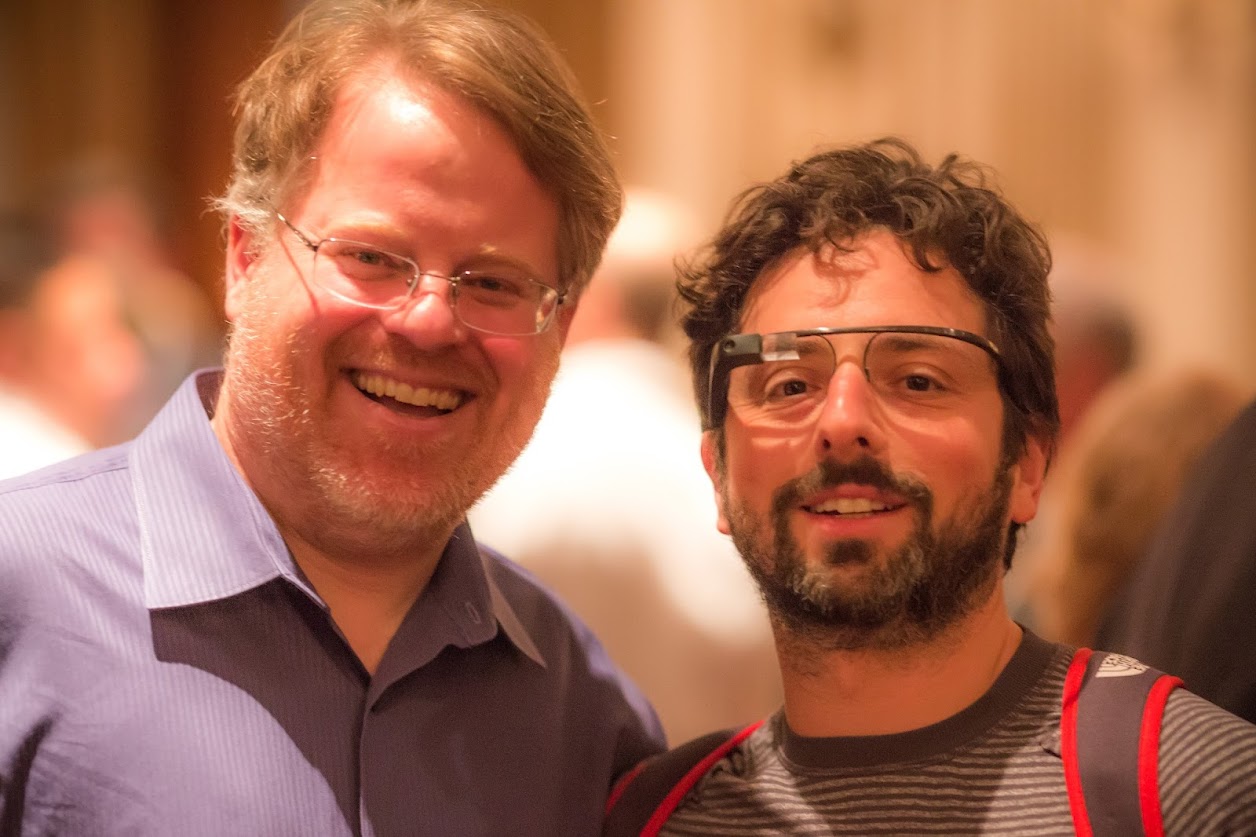
Get it going, add the "obvious" camera functionality on some models and off it goes.
Instead the camera was fundamental to the design, and to my knowledge represented about 90% of the use-cases demonstrated for the device...without even offering AR.