One thing to keep in mind is that many institutional investors, including those in Europe, are required to invest exclusively into triple-A instruments. This downgrade means a major sell-off of US bonds and whatnots currently held by such investors, and that could have an interesting avalanche effect.
Does it? Many institutional investors don't treat U.S. Treasuries as ratable bonds, but a separate category (they aren't lumped in with AAA corporates in investment strategies, for the good reason that they have quite different characteristics).
Based on the slim case studies we have so far, the S&P downgrade of Japan in 2002 had approximately zero impact on Japanese bond rates. It doesn't even show up as a small blip on the 10-year graph; was just completely ignored.
That's because Japanese debt (up to this point) has been primarily financed by its own citizens, life insurance and pension funds. These are more likely to accept sub-AAA rated bonds and support their own government than external investors are.
Even as we speak the Euro is breaking apart. Europeans are pouring billions of dollars into U.S. currency, bonds and investments even at a loss, even after the S&P downgrade. Yesterday Bank Of New York Mellon told depositors that they would only accept investment if the investor accepted a _negative_ interest rate!
Because things are worse in Europe! The Greece financial crisis is ripping the Euro apart. The U.S. remains the best haven in a lousy neighborhood (the world): better than Europe, better than China, better than Asia.
We should obliterate S&P, Fitch and Moody's for their financial crimes during the financial meltdown. More trustworthy firms will rise to replace them. Meanwhile investors will become appropriately wary of investing in financial instruments about which they know nothing.
I don't think this is correct. Planet Money did a recent podcast on this very subject (Would A Downgrade Matter?)[1], and they concluded that a downgrade from AAA to AA+ doesn't matter very much in the long run. Yes, it's somewhat embarrassing, and interest rates are likely to go up _slightly_, but that's about it.
The big leap is from "investment grade" securities to "junk bonds" ('BB'/'Ba' or less). We're still a long way from there.
Maybe long-term the interest rates don't go up much. But the main impact is a huge rocking-the-boat in the banking system : one of the bedrock ideas has just changed. You wouldn't want to do this if the banking system were strong. Now is really not a good time...
I'm sorry but this seems alarmist to me. Any automated system can make an exception. For your logic to hold these institutional investors would have to not take notice of the U.S. Government having its credit rating dropped. You're arguing they'd treat the United States and "any other investment" and rely on an automated system.
That's not going to happen.
Plus S&P's logic is shaky on this. The whole reason the threat of S&P dropping our rating has had no impact is because their demands were impossible to achieve. Cut $4 trillion from the budget in 10 years when we're expected to add $9 trillion in the next 4? Not possible and everyone knows it.
I think they sending a clear message to the US government to get their financial house in order. The fact this has never happened (to either democratic or republican presidents in the history of the country) is a major issue.
Imagine if we actually passed the balanced budget amendment back in 1997 - things would be a LOT different.
In the most recent Planet Money podcast they claimed that a downgrade from AAA to AA would have no effect on investors. This is way out of my area of expertise but they seemed quite certain on this point.
This is by far the biggest problem. I don't think anybody realizes how huge a sell-off that's going to be if the institutions apply their rules about AAA debt to US bonds (a big if, as others have noted).
A sell-off of bonds would make it more expensive for the government to borrow money, which would further accelerate the expansion of the deficit. The deficit is the primary driver of the downgrade, so an acceleration would trigger further downgrades.
Treasuries act as a money store for large institutions that I think would be hard for them to replace in practice. They use T-bills in particular as more or less a jumbo-sized version of an FDIC-insured bank account. Where would they move that money to? I.e., who else provides a similarly safe account where you can deposit $50 billion? Can't be to a bank account, because all the major banks have even lower ratings. There aren't enough AAA-rated corporates to move all that money. Eurozone bonds aren't looking too hot, and may also have institutional rules on proportion of the investment that can go into foreign bonds. I suppose they could buy large quantities of gold and physically store it in vaults, but many institutional investors also have rules on how much they can put into commodities. Perhaps giant suitcases of dollar bills? You can't pull money out of an instrument without putting it somewhere else!
You could, for example, move your money to Canadian treasuries, which are AAA rated, couldn't you?
I am admittedly learning much of this as I read, but it seems to me that a large concern would be the amount of money that might simply shift out of our economy to economies with better (safer) credit ratings.
Perhaps; it depends on whether investors have rules about percentage of foreign holdings (many do). You'd also need to find countries with AAA ratings that still have big enough outstanding debts that the markets are sufficiently liquid even for large transactions. For example, Canada has $550 billion in total outstanding bonds, so you couldn't easily move $50 billion there, since that'd require buying up 10% of the entire market. Even moving $5 billion there is buying up 1%, which the liquidity may or may not support.
The credit rating agencies (S&P, Moody's and Fitch) don't know what they are doing! They enabled the financial meltdown. Their ratings are not useful. Their numbers are bad. They are either corrupt, inaccurate or both.
It would be nice and easy to believe that, since S&P puts a "AAA" beside a company's name, that the company is solid. We now know that is false.
Pay attention to Nicholas Taleb's writings: the financial models commonly in use don't work - don't trust them. Use more conservative measures. Avoid markets where you cannot quantify risk.
I think at least one of the issues is that other AAA countries/entities simply don't produce enough debt. It' not just that we're AAA, it's that we produce so much AAA paper. The AAA bond market gets so much smaller is the issue. That's my understanding, but I'm no expert.
I think that is largely why this won't have that much of an effect, there isn't a replacement for that much money that is AAA. The "cure" (crowding into what is left) would be more painful to the bond market than the "disease" (us).
Damn you, but the boys at Goldman Sachs are probably on it, right now. Take a pile of T-bills. Siphon off the income from them into a pie. Cut the pie into tranches. The first tranch or two are guaranteed to be AAA. Just look at the math that the quants derived...
Old joke: If you owe the bank a thousand dollars and you can't pay it back, then you have a problem. If you owe the bank a billion dollars and you can't pay it back, then the bank has a problem.
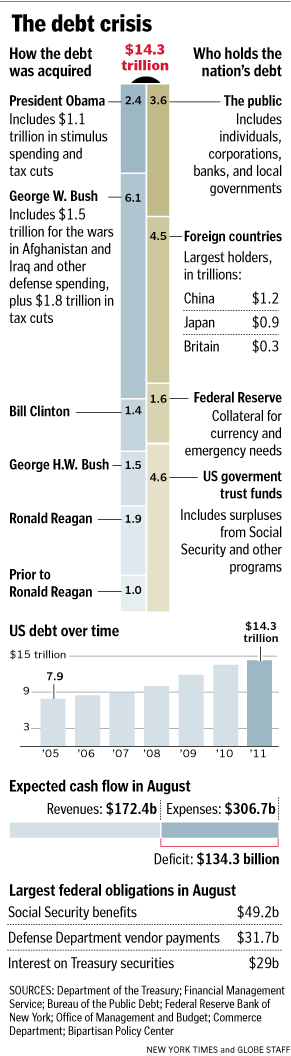
It'd have to get very bad for China to pull out. If China pulls out and damages our economy, our imports will dry up, their exports will dry up and their economy will dry up. I understand that China and the US might not be the best of friends right now, but their interests are generally aligned on US debt.
Its really not. If what you say was true they wouldn't still be actively buying U.S. Debt.
Their hesitation is they wouldn't get all their money back. If China pulled even 25% of its investments out of the U.S. the dollar would free fall. They wouldn't be able to cash out before most of the dollars value was inflated away.
China continues to buy our debt because they don't want the value of their current investment to collapse
I don't think de-invest is an actual word, but I will role with you on this. Investors treat U.S. Treasury bonds like cash. A lot of financial transactions are actually done with Treasury notes, because they are considered extremely safe and reliable, and unlike cash, they generate interest payments. If investors don't like the downgrade, then they will sell off their bonds for cash. Cash is theoretically the safest asset you can hold (some would argue that gold is, but that is a different topic). Cash never decreases in value (relative to itself at least, it can change value when compared to other countries currency, and inflation can take it's toll, but once again, this is a different topic), whereas treasury bonds can.