In 2004, when Cassell sentenced Angelos, he wrote a lengthy opinion, comparing Angelos’s sentence (738 months) with the guideline sentences for the kingpin of three major drug trafficking rings that caused three deaths (465 months), a three-time aircraft hijacker (405 months), a second-degree murderer of three victims (235 months) and the rapist of three 10-year-olds (188 months).
Where is the justice? Is there anyone who could argue this is the way we want our judicial system to work? Why can't we fix this already?
Like almost everything the government does that's stupid on its face, mandatory minimums were a reaction to a different problem. Voters were angry because there were wide disparities in sentencing, and it seemed some judges were wont to give out light sentences no matter how heinous the crime. It's probably not unreasonable to say "If you kill someone, you should serve at least this amount of time regardless of circumstances."
It's also not unreasonable to think large disparities in sentencing are fundamentally unfair. The amount of jail time you get is supposed to depend on what you did and not which judge presided over your sentencing.
But along the way mandatory minimums became a way for politicians to project the "tough on crime" image. You'd have a news article about a guy who just got out of jail killing an eight year old in a botched drug deal, then the next day Senator Simpleton is there at a press conference announcing a new bill to add 25 years to everybody caught with a gun at a drug deal.
It's virtually impossible for any politician to stand up at that time and say "That seems like an awfully long sentence for being in possession of a firearm."
I'm in the state of Victoria in Australia. While we don't have the truly ludicrous sentencing that the US does, we have our own share of tabloid-driven "lock-em-up-and-throw-away-the-key" vocal idiots who don't think of the whole picture. Every sentence is met in the public eye with "that's too short!"
Anyway, the law institute of Victoria did a study where they asked members of the public what an appropriate sentence would be for real cases (without telling them the actual sentence). The kicker was this: the survey included much more detail on how the crime occurred. It wasn't just a throwaway line in a paper, but gave context. Turned out that the respondents suggested sentences that were actually shorter than were given in court.
The whole "tough on crime, because votes" is a hideous thing, because most voters don't think about the big picture.
Yes, correct, but that's not what the populace wanted at the time. Despite the fact that weakening that by definition is weakening the justice systems ability to mete out real, actual justice.
Not really, your punishment should fit the crime and therefore be related exactly to what you did (and the circumstances in which you did it) - and definitely not based on which member of the judiciary you are randomly assigned.
So yes, whilst judges are supposed to have lots of discretion- there should also be oversight to ensure they're somewhat aligned with each other.
Mandatory minimums are a populist solution to headlines about setencing.
"People ask me sometimes, when — when do you think it will it be enough? When will there be enough women on the court? And my answer is when there are nine." -Ruth Bader Ginsgurg
Yup, that discussion is now raging (at least in academia, and a bit in politics) in the Netherlands, particularly in and around 2012 when there was a new law proposal for mandatory minimums. Judges all around the country were strongly opposed, despite them appreciating the issue of different judgements for different people.
The law however is a lot more sensible. For one it's for repeat crimes, but only of a certain order of the first one. i.e. if the first crime carried a 10 year sentence, then a repeat crime would carry a mandatory minimum of at least half the full sentence on that crime. You wouldn't have the issue of three strikes out for example, because none of those crimes are large enough to fit the mandatory threshold. (Further, while marijuana is illegal in the Netherlands, normal use is never prosecuted anyway, which we call the 'gedoogbeleid', loosely 'tolerance policy'. i.e. it's technically illegal, but it's country-wide policy to ignore it. Like if a police officer catches you walking through a red light on a street that has no traffic for hours because of an accident further down the road.) Still I'm not a fan. Judges are imperfect but I feel they're less imperfect than mandatory minimums. At the end of the day, our judges are independent and highly trained. Further there are various instruments to ensure independence, like appeals or even rejecting the judge and replacing him or her with a different one. (right of substitution).
It is basically an end run around the 2nd amendment. Since the anti-gun lobby cannot outlaw them completely they tack on automatic sentence multipliers for any crime where a gun is found even if the gun was not directly used.
Oh, FFS. 924(c) was enacted in 1968. I don't think the "anti-gun lobby" (as disingenuous and argument-poisoning a phrasing as "death tax" or "pro life", if you ask me) was much of a thing then, and even to the extent it did exist, it certainly wasn't anything like the thing that the "Mah cold, dead hands!" crowd reflexively vilifies today.
In 1970 924(c) was 1 year mandatory and 2 year for subsequent using or carrying a gun during a felony.
In 1984 they changed it to 5 years for carrying a gun during a "crime of violence". 20 for subsequent.
In 1986 they added " during a drug trafficking crime ".
In 1998 in addition to use or carry they added "possesses" "in furtherance of any such crime." And they increased the subsequent minimum from 20 to 25.
Note that these were all Republican congresses so i agree that the anti gun theory doesn't really hold that well, it was mostly just "tough on crime" hysteria. The 1986 drug stuff was in response to some basketball player, Len Bias, that died of an overdose.
Ummm, the House was held by the Democrats for all the dates you mention except 1998, the Senate for the first two https://en.wikipedia.org/wiki/Party_divisions_of_United_Stat...). And you're wildly mistaken that party affiliations mapped that closely to official positions on guns till the 1990s, and to this day it's much easier to be an anti-gun Republicans like those now pretty much only found in NY or Illinois than, say, an anti-abortion Democrat.
Here's a brief outline of the "anti-gun lobby's" successes in the US:
Prior to the Civil War: bans on concealed carry ostensibly to discourage dueling.
Post-Civil War: bans mostly in the South on carry, or types of weapons allowed to be carried, to keep blacks disarmed.
Early 20ths Century: More widespread bans on carry, and restrictions on handgun ownership, prompted by the waves of non-Anglo-Saxon immigrants. New York's Sullivan Law, named after a gangster politician who disarmed his southern and eastern European rivals with it, is still the law of the land there.
The National Firearms Act (NFA) of 1934 was the first national level gun control law, which as a "compromise" didn't effectively ban the transfer of handguns.
Lots more where this came from with of course enforcement beyond the initially targeted populations, by the early '60s it was a big thing that Washington State passed a shall issue concealed carry licencing law.
Big push in the '50s and '60s to restrict gun ownership, especially of handguns (I've read many contemporaneous issues of the NRA's American Rifleman membership magazine that covered the Congressional hearings etc. on this, generally lead by the criminal Senator Thomas Dodd, ah, I see he also got LSD banned: https://en.wikipedia.org/wiki/Thomas_J._Dodd#Congress).
The Gun Control Act (GCA) of 1968 completely changed the way guns were sold in the US, opened the door for massive abuses by the BATF that were well on their way to extinguishing the country's gun culture when party reversed in 1986, etc. etc. etc.
The anti-gun lobby was very much a thing that very year, the GCA pretty much marked the beginning of their greatest successes in the country. If we "reflexively" vilify the gun grabbers today, it's because it's been such a thing, and so strong for all of our adult lives for the majority of us (those of us less than 65 years old, including all Baby Boomers born starting in 1950, those of us less than 100 years old if you include that Federal effort to effectively ban handgun ownership with a $3,500 transfer tax in 2015 dollars).
See, that's exactly what I'm talking about with argument-poisoning. When you spout rhetoric like "gun-grabbers", you're telegraphing not merely disinterest in, but active disdain for productive discourse. You're effectively telling me that don't want to discuss the issues, you just want to regurgitate propaganda, and name-call everyone who doesn't toe your party's line.
I mean, I know this is contemporary America, where taking a considered, nuanced position on any hot-button political issue is just asking to be pilloried by both sides (because somehow, we have this quasi-magical ability to reduce every meaningful question to two antithetical camps who proceed to do nothing but insult one another), but we're supposed to be smarter and better than that here. Isn't that what nerds have prided themselves on for as long as nerds have been a thing, being smarter than everyone else?
There is absolutely no productive discourse to be had on this subject from the viewpoint of gun owners.
That is point is hammered home by your harping on my mild rhetoric compared to your ""Mah cold, dead hands!" crowd reflexively vilifies today", without addressing a single one of my points about how you were wrong on every claimed fact in your posting I was replying to.
It also spits on the 8th amendment's provision against cruel and unusual punishment. A lifetime of incarceration for a non-violent offense isn't a fitting punishment nor a suitable use of government power.
I have come to understand this brutal sentencing structure, or at least some of the reasoning. It appears to be the "other side" of the question "how many guilty men should go free for how many innocent men"? The strength of the punishment is proportional to how hard it is to convict with certainty. The aggressive sentencing is greatly exaggerated to form a disincentive for all the men we cannot convict.
Justice strikes me of an area where humans tend to reason intuitively. It's also an area that is extremely difficult to measure in any quantitative way. I would be highly interested in understanding what drives existing criminals--my own intuition tells me these sentences are not very preventative, but allow for the illusion of making progress against crime, particularly violent crime. (These people are monsters! Thank god they're gone for life, or the dangerous part of their life.)
The disincentive of aggressive sentencing is just well-wishing. When I committed my crime, I was not even aware of what laws I was breaking or even the amount of punishment I could receive. Most of the men I knew in prison also were not thinking of consequences at the time they were being bad boys. I would say the main exception to this were the men who had been in organized crime.
There is the fact that criminals are less able to commit further crimes while in prison.
It's not foolproof by any means, but I'm kind of comforted by the fact that the man who deliberately ambushed and murdered mom with a hammer, then later threatened to do something like that to grandma cannot, in fact, pay us a visit barring some failure of the prison system.
> There is the fact that criminals are less able to commit further crimes while in prison.
This presupposes we catch the criminals. This doesn't really match up with reality—it's actually quite difficult to get any conviction from some murder cases, for instance. In a limited sense, what happens to the individual doesn't matter nearly as much as laws affect crime rates.
I was pointing out that prison, as a sentence, serves a use beyond mere retribution. The fact that some criminals are never caught is not relevant to that claim.
My understanding is that this has been studied, and criminals are deterred almost entirely by the certainty of being caught, and almost not at all by the severity of punishment.
The problem with this line of argument is the assumption that deterrence is the only purpose of punishment. Justice (in the hard-to-quantify sense referenced by the GP) for the victim and community (and on a practical tangent, the deterrence of vigilante justice) is a pretty significant purpose of punishment.
The fact it allows the death penalty shows that the 8th amendment is essentially meaningless. Glossip v. Gross showed that SCOTUS doesn't even care how the death penalty is carried out. If the state can kill you slowly and painfully, why do you expect it to prohibit anything else?
I'm an NRA member, and not totally opposed to multipliers for carrying a gun while committing a crime. With great power comes great responsibility, and all that.
Although I do think 55 years is excessive in this case.
However the common crime or sentencing enhancement of breaking and entering with a firearm has clear and important motivations, it's a signal the criminal is entirely willing to use lethal force against others while in the commission of that sort of crime. Those and the more direct sort of forcible felonies have an inherent element of violence in them. Merely selling drugs---a voluntary transaction---while armed is a different thing.
The logic is that you're more likely to use the gun during a crime - regardless of the crime, whether or not it's victimless, or even if the law is unjust.
Yes, a drug purchase is a voluntary transaction, and yes, I believe drugs should be decriminalized. However it's undeniable that black markets are violent and that innocent bystanders get caught in the crossfire. The sentencing guidelines are there to punish and/or deter that.
"Carrying a gun during a crime" is not "having a gun at home", unless you're doing the crime at home. It's particularly hard to do the crime of breaking and entering at your own home.
There's some confusion in this sub-thread. I was originally replying to the comment:
> Since the anti-gun lobby cannot outlaw them completely they tack on automatic sentence multipliers for any crime where a gun is found even if the gun was not directly used.
which is about carrying a gun while committing a crime.
In general, I don't think you should get a harsher sentence for having a gun at home, away from the crime scene. However it's a grey area when you're running a continuous illegal operation using your home as a base.
> Since the anti-gun lobby cannot outlaw them completely they tack on automatic sentence multipliers
I rarely hear anyone say they want to outlaw guns completely, but perhaps that was meant as hyperbole? In any case, do you have some evidence that the multipliers were a reaction to difficulties in regulating guns?
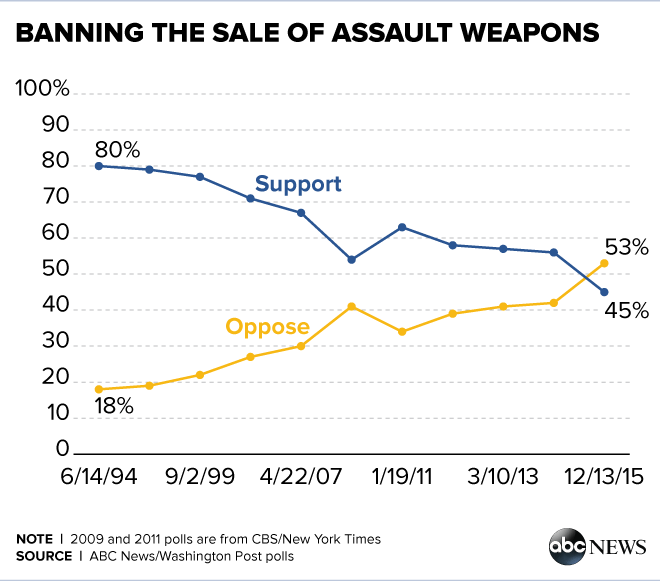
Most Americans believe guns should be regulated more stringently; I would guess that they believe these laws are just, not a political trick. Also, at least sometimes American law more stringently punishes crimes committed with any weapon, guns or otherwise, than crimes committed without one.
The long term trends have been overwhelmingly in the direction of more support for gun rights, not fewer.
This is one of those topics where US preferences and those of HN (which has drawn a more and more international audience over the years) have been moving in opposite directions.
> This is one of those topics where US preferences and those of HN ... have been moving in opposite directions.
I'm not sure I agree. Many posts that even mention simple facts (not arguments) that might be harmful to the proliferation of guns get immediate arguments and voted down. [EDIT: For example, my post above is down to -2.]
(See my post below for some more polls that might interest you.)
> the 45% of Americans who don't want stricter gun control? I wouldn't call those people a "special interest group".
I agree, but I don't think state legislatures' actions are very responsive to public opinion: 1) Very few citizens vote in state legislative elections or pay attention to what happens in their state capitals (for example, how many people reading this can even name their state legislators?), and 2) because gerrymandering makes many districts guranteed wins for one party, few legislators' seats are at risk.
In the end, the political parties decide who gets what seat and in many cases I think they are heavily influenced by special interests. Many bills in state legislatures are written by lobbyists, in fact. Look up ALEC, for example, or in this case the NRA.
55% who want it to be more strict is still more than the 45% who don't want it so or are undecided. If this were a voting matter, picking up 15 percentage points means nothing if it still doesn't take you past your opponent's percentage.
And the whole point of a constitutionally limited republic is so that 55% cannot dictate to the other 45% unless they can successfully argue that what they want is right rather than merely popular.
You get the same number of votes every election, regardless of how many facts you know or opinions you hold. We really don't want to live in a society where 51 idiots can overrule 49 geniuses. (Insert insult against congresspersons here.)
The polling numbers only tell the more spineless representatives how much risk they will take with regard to reelection if they choose to act with due consideration of all parties' interests rather than pander to their base or log-roll with their peers.
Thing is, most high population states are "pro-gun" if you score that as having a shall issue concealed carry regime.
If for no other reason than that they total 43, and out of the 7 restrictive states, only those two are "high population", the others being Hawaii (40th in population), Maryland (19th, ~1/3 of NY), Massachusetts (15th, ditto), New Jersey (11th, ~1/2 of NY), Rhode Island sort of (43rd).
And you have to go down to 29th ranked Connecticut before you get to a de facto shall issue state. California and Massachusetts are also de facto shall issue in many counties/towns, although obviously not most of the high population ones.
In the Bay Area, where I live, guns are completely illegal to carry outside of your my house unless I am a celebrity or have a residence elsewhere in California where I can actually get a license issued.
> He received five years for the gun in the car; 25 years for the second gun charge, having one in an ankle strap; and another 25 years for a third firearms charge, the gun police found in his home. He got one day for the marijuana.
Pretty disingenuous for the lede to lay this all on the war on drugs when the real reason for the long sentence in this particular case is the war on guns.
> His case has been widely championed, including by Utah’s Republican Sen. Mike Lee, former FBI Director Bill Sessions, the group Families Against Mandatory Minimums and conservative billionaire Charles Koch.
Food for thought for those who think the drug war was/is driven by the "establishment" rather than by the grass roots of ordinary voters.
924(c).Federal drug laws require 5- to 30-year mandatory minimum sentences for possessing, brandishing or discharging a gun during a drug-trafficking crime.
By my reading of that, this applies even if the gun itself was entirely legal.
Right, it punishes people for having a completely legal firearm present during another crime. Wouldn't you think that's to discourage guns just as much as to discourage trafficking?
You can't concealed carry if you're in a bar either, or if you're intoxicated. There are tons of laws around guns.
So if you're a "smart" drug trafficker, you'll forego the weapons. Distributing drugs doesn't seem to be a good risk-reward choice IMO. Maybe these dealers/distributors should evaluate their possible outcomes if they don't like 55 year sentences.
You can't concealed carry if you're in a bar either, or if you're intoxicated. There are tons of laws around guns.
That depends, the laws are so wildly varying that there are many states that allow concealed carry while at a bar, see e.g. the 2010 chart here: http://www.2acheck.com/but-you-cant-carry-a-gun-into-a-bar/ and as the article noted, states have been loosening their restrictions since then. Separately I noticed that includes Ohio as of a few years ago, and many of the in-between states have a "51%" law where it's OK if the establishment earns less than the majority of its income from alcohol. Virginia was in a weird state for a while, requiring you to unconceal while at one, a loophole in a poison pill added to the law that finally made it shall issue in the state.
Being "intoxicated" is a lot more complicated: certainly, in any jurisdiction where you come to the attention of the police while being both there are general laws that'll get you. But I seem to remember that at least one state, maybe my Missouri, allows even being intoxicated (as I recall, that was due to police arresting someone in his home where he had some guns while he was intoxicated). Many states allow carrying with a degree of alcohol in your blood short of legal intoxication (which can be below the statutory norm of 0.08%).
"[Count #1:] ... observed Mr. Angelos' Glock pistol by the center console of his car. [Count #2:] .... Mr. Angelos lifted his pant leg to show him the Glock in an ankle holster.... [Count #3:] The search revealed a briefcase which contained ... a handgun .... also recovered two other guns in a locked safe, one of which was confirmed as stolen. .... two more guns ..."
In short, five guns were found under Angelos's control. The two possessed during transactions are perhaps the same, but may or may not be one of the three found in his home. I believe the sentence "Officers later searched his home and found a gun." from the original article is misleading; officers found three.
In any case, the government charged Angelos with five §924(c) counts: two counts for the one during transactions, one count for the three guns found at his home, and two more counts for the two guns found at his girlfriend's. The jury found him not guilty of the last two counts.
"A slim majority (53%) of Americans say the drug should be made legal, compared with 44% who want it to be illegal. Opinions have changed drastically since 1969, when Gallup first asked the question and found that just 12% favored legalizing marijuana use. Much of the change in opinion has occurred over the past few years — support rose 11 points between 2010 and 2013 (although it has remained relatively unchanged since then)."
That's not support for the war on drugs. I think LSD should be illegal, but be a misdemeanor with a minor fine.
Actual support for long prison terms for 'minor' crimes has always been fairly low. But, you can get wide swings based on how you phrase the question. Remember people say tough on crime, not here is what I want to do and this is how much it's going to cost.
It might be fine at low usage levels. But, I have known a few heavy users who where harmed by it. I don't expect being a minor fine will have a significant effect, but it is likely to discourage some people which IMO is a good thing.
My point is that all drugs have risks and harms associated with them. Criminalizing them in anyway is the wrong way to address that (and it's historically never been the real reason for doing so -- it's been about oppression of minorities and dissidents).
It's not going to prevent prevent people from using in the privacy of there own home. It would discourage people though, and with long term negative effects for many users that's probably a good thing IMO.
I would be in favor of limiting how strong you can make alcohol without paying a prohibitive tax. AKA, buying higher proof should not be the cheaper way to drink.
I'd venture a guess that many more politicians in Congress and elsewhere are aware of how stupid drug prohibition is than will publicly admit it. Remember, a lot of them are genuine intellectuals, with some of the sharpest young policy experts in the country working for them. Politics is the art of the possible, and ending drug prohibition is a political nonstarter right now.
Unfortunately, the weed legalization movement has been succeeding with the "weed isn't that bad for you" message, which is a half-truth that will undermine further liberalization, and has failed to shift the debate regarding the War on Drugs overall.
The good arguments for ending the drug war, which the general public is not aware of, are: 1) Prohibition empowers violent criminal organizations domestically and internationally, 2) People should be free to put whatever they want in their own body and earn the consequences, and 3) Prohibition of popular drugs puts otherwise law-abiding people in contact with the criminal underworld.
Try this at home. Tell your friends "I think all drugs should be legal". My experience is that you're going to get strong disagreement from the vast majority of people, even the more liberally-minded ones. Decades of propaganda have been effective.
Without the drug charge my guess is the other charges would be reduced. Guns + other crimes almost always means much longer sentences. The article is vague on this, though, so we don't really know.
The maximum sentence for dealing under 50kg of marijuana is five years, and there is no mandatory minimum. He would've gotten just a few years if that for the actual drug charges if the anti-gun folks hadn't lobbied for astronomical gun-related penalties in the drug laws.
How is it that this person was convicted on three gun charges, when two of them were (according to the article) based on nothing but the testimony of a single person? The sentence is absurd even if the gun charges are all true, of course, but this seems like an amazingly lax standard of proof as well.
It has to do with the way that sentences are enhanced after a conviction. Probation officers are assigned to research the "facts" of a case after a conviction and write a Presentencing Report for the judge.
Federal sentence ranges are computed using a grid system. Different "facts" adjust the row or column of the eventual range of months a judge legally has to sentence a person within. Probation officers can be extremely thorough and throw in all kinds of things, or can omit things in the sentence computation.
If a person makes a plea agreement with the Prosecutor, they are essentially saying that such and such facts are relevant and these other ones don't apply to the sentence. If there are any possible enhancements not nailed down in the agreement, the Probation Officer can come in and say these are relevant and surprise! Your 5 year plea just became a 15 year sentence.
(edit) Also, multiple convictions for crimes typically have the sentences run consecutively.
In short, the facts on which you're convicted may be completely different from the facts on which you're sentenced? Sounds like a rather blatant end run around the whole "beyond a reasonable doubt" thing.
Correct. Federal supervision officers have a great deal of discretion when writing their reports. They can take information that has never been shown to the judge and use it to enhance the sentence guidelines that the judge has to follow.
Besides, the reasonable doubt part only applies to a conviction.
Remember folks, now that Rand Paul has dropped out, there is one candidate left who is not a drug warrior. This will be the easiest vote I've ever cast.
Edit: I was not fair to Trump on this. He apparently isn't a drug warrior. Still gonna be an easy vote for me though!
> but Trump has said let the states do whatever they vote for.
Not just that, but Trump supported marijuana legalization as far back as 1990. That was right around the height of the war on drugs, in between "Just Say No" of the Reagan years and the anti-drug, tough-on-crime propaganda of the Clinton years.
I can't really endorse pretty much anything else Trump says, but it really can't be overstated how rare it was for anyone to be standing up for marijuana legalization (publicly) 25 years ago.
He also seems to support single-payer healthcare, and has complimented the system in Scotland. Funny that GOP voters seem to give him a pass on all of the sort of issues that would kill other candidates' chances.
Right, because ideological purity is much better than pragmatism. You have no preference at all between the candidates, because none of them favour complete legalisation? You'd rather have no decriminalisation than just some?
The drug war is only one of many reasons that I am apolitical. I don't accept that I have a legitimate choice -- to me, voting would be tacit acceptance of the legitimacy of our political process.
Sanders filed a bill to remove cannabis from the controlled substances act altogether, which would defer any decision on its prohibition or legal status to individual states: https://www.govtrack.us/congress/bills/114/s2237/text. It's not full all-at-once nationwide legalization, but it's not a mere decrease in federal penalties either.
Correct me if I'm wrong, but it seems like the gun related charges have caused two issues to happen here:
1) The minimum sentence was exceptionally harsh.
2) Because of the guns, it makes it somewhat of a political hot potato since it looks like he "could" be violent.
Any law that mention guns that simply counts their alleged presence is bogus. I can see if it was used in commission of a crime but not "he might of had one in the car". If you judge owning a gun = violent the you are part of the problem that sentences people like this to unjustified sentences (edit: I do not assume that is the parent poster's opinion).
You're right. My only point was that in this case the guns are a double whammy, they both caused the ridiculously harsh sentence and then also probably the political reason he's not getting the sentence commuted.
This guy sells marijuana 3x, $350 each, to a narc. He gets 55 years.
Jeffrey Keith Skilling, poster child for white collar crime, convicted of conspiracy, insider trading, making false statements to auditors, securities fraud, and insider trading, gets 14 years.
The justice system in this country is more fucked up than I could have thought possible.
So what would happen to a federal judge if he just didn't impose the mandatory minimum sentence in a case like this? Wouldn't the constitutional separation of powers protect him from any consequences?
So the sentence potentially gets overturned on appeal, great. The appellate judges should refuse to apply the sentence.
So they get overturned on appeal to the Supreme Court, great. The Supreme Court should refuse to apply the sentence. Or, I guess they can spend their time overturning thousands of decisions per year.
Burn it down, and then what? The only precedent the article cites is the French Revolution. How did that work out?
Now if you had said, appeal the case all the way to the Supreme Court in the hopes of getting the mandatory sentencing law in question declared unconstitutional, that would be fine. But that isn't what you said.
Although that response (by Zhou Enlai) was, of course, based on misunderstanding. Zhou thought the question was about the 1968 riots and consequential societal change, not the 1789 revolution.
No one put a gun to the head of the judge in question and forced him to do anything. He simply could have chosen to not apply the sentence. Likewise the court above him, and so on.
This is a far cry from the guillotine (some might say the opposite).
> He simply could have chosen to not apply the sentence.
Not if he wants to uphold the law. As soon as you replace the law with personal whim, you could end up anywhere, including the guillotine. There is a way within the law to challenge it; but that way is not to just refuse to apply it if you don't like what it says.
You are under a misapprehension that "naked exercise of personal power" means a judge upholding a law he doesn't like, when actually it means a judge unilaterally choosing not to uphold that law and substituting his own personal opinion instead.
That's not to say that I'm a fan of our current legal system; I'm not. It is highly unfair and does a very poor job of getting justice done. But it's still better than what we would have if everybody could disobey all laws they didn't like with impunity. (If people disobey laws and then take the consequences, that's different--if the judge had refused to impose the sentence required by law, and then had accepted being fired for failing to uphold the law, that would be civil disobedience, and sometimes that's necessary. But that's not what you're advocating, as far as I can tell.)
I am not restricting myself to looking at the role of judges in a vacuum. Prosecutors, police, regulators, etc. all make individual decisions that amount to "I will fuck this guy up, because I don't like them". They typically have absolute immunity in making those decisions - as do judges, actually. It makes no sense to condemn judges for exercising mercy contrary to the law in one breath, and in another give prosecutors absolute immunity for their charging or investigatory decisions, regardless on what basis they were made. We evidently wanted a system where no state actor ever faces punishment for any decision they make, and now we have it.
> We evidently wanted a system where no state actor ever faces punishment for any decision they make
Exactly--which means those actors are not exercising "naked personal power"; they are exercising the power as state actors that we gave to them. So if we don't like what they're doing with it, we need to take it away.
We have sentences for crimes that are way too extreme in many cases because we told lawmakers with our votes that we wanted them to be "tough on crime" and that we wanted them to wage war on drugs. We have prosecutors and cops who have essentially unlimited discretion for the same reasons. We have a legal system that favors the rich because incumbent politicians who favor their rich donors have a re-election rate in the high 90's even though their approval ratings are in the single digits. The system we have is not "naked personal power"; it's the system that we, the voters, voted for. Democracy is working exactly the way it was designed to work. Burning it to the ground would not make it work better; it would make things worse. The way to make it better is to change the incentives of those who make the laws, by telling them different things with our votes.
I know I shouldn't feed the trolls.. but are you honestly advocating murdering a Federal judge who followed sentencing guidelines? Exactly who should be put to death here?
Technically, someone can bleed without dying, but more seriously, this type of case isn't all that unusual, and it is so blatantly and obviously wrong, I don't think a logical argument can fix it. Sadly, some people only learn through force.



Where is the justice? Is there anyone who could argue this is the way we want our judicial system to work? Why can't we fix this already?