Indeed! When I first learnd that the English equivalent of...
Do Ré Mi Fa Sol La Si Do
... is...
C D E F G A B C
... it blew my mind :D I mean, I can see the point in using letters instead of words, alright. But why in that order?
Even today I can't find the origin/reason for that -- apart from "It's a German thing" apparently.
It could be just that the "German key notation") and the "Fixed Do key notation" were each created independently centuries ago, and thus differed. And once each system spread and reached users of the other, well, hello, my Do is your C and my A is your La :)
Maybe more importantly, it is in that specific order because it is the key of C major! The A major scale is for example would be A, B, C♯, D, E, F♯, and G♯ ...
In fixed Solfège, that would become La Si Do ... but in movable Solfège, Do would be A, Re would be B ...
And I didn't know about Movable Solfège, thanks! I'll have to study that.
But, to put it in audio perspective rather than comparing words and letters, why is the note that corresponds to 440 Hz named A and not F -- implying that, going lower and lower from 440 Hz for each note, 261.63 Hz would not be named C but rather A instead.
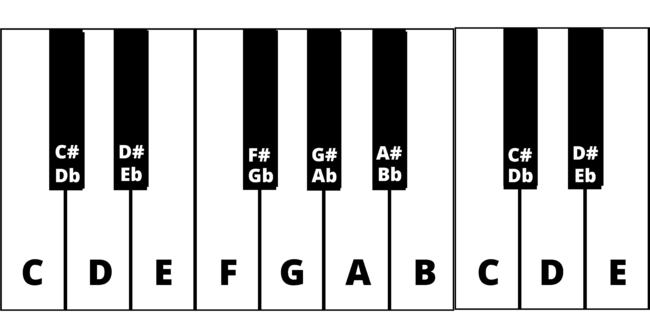
Or, to use maybe a comparison that would work from whence those two notation systems were created/named (I figure with a keyboard nearby), why is the first note of a standard piano octave (you know, this: [1]) labelled C and not A? Since it's the first note of the octave and since the German system is using the alphabet (which, well, starts with A), wouldn't it have made sense to have that first octave piano key be labelled A too :)
I've seen this conversation several times online, and it's funny to see how participants cannot agree on what is being talked about here, and no conclusion is reached. So I'm aware that I might be asking a super dumb beginner question, but I really do wonder why Do=C and not Do=A.
Don't hesitate to slap me with a "origins of musical notation systems" link, I love to read about music and history :)
The easy answer is that the piano is not the "reference" instrument. If you look at a violin, the A major scale is generally the first scale you learn -- not C.
The piano has C natural in the middle of a full 88 keyboard, which is why it is a "natural" scale to pick (C major only uses the white keys, while A major would use three black keys).
So if you are learning another instrument, your "base" note will sometimes be entirely different.
Many "non-western" tradition also aren't tuned to 440 Hz, and even many _western_ traditions don't use 440 Hz for A, 415 Hz is also common.
[addendum]
And why Do/Ut, Re, Mi? Because of a Gregorian chant where each sound sorta fell into a vocal range of monks ... then you adopt Do to whatever "sound" the instrument is closest, many years pass and deviations and standardizations ...
[addendum]
I recommend starting out researching Guido d'Arezzo (and the Guidonian hand) a bit, that is where we get do/re/mi .. which was used as a teaching aid (which is maybe why Solfege as a term is often used in combination to sight reading or singing from sheet music). Almost no matter what language someone sings/voices Do/Re/Mi/... ... it falls naturally into a vocal range, irrespective of octave.
And then one could look into the hexachord ... and deep into a very deep well of confusion.
> The easy answer is that the piano is not the "reference" instrument.
The question make sense without ever thinking about piano. The question is: how come the notes named only by letters (without any accidentals) form a major scale, and yet the note A is not the first note (or tonic) of that scale.
The answer is probably related to the fact that those notes also form other scales (seven of them - seven diatonic modes, one of which corresponds to major scale), and it's only relatively recently that the major scale took a central role in music theory.
You will need to blame Boethius, musical notation is a quagmire of many systems that have been merged over centuries. If you venture into non-western systems, it becomes even more fascinating.
Maybe we should make one more standard .. that consolidates all of them? ;-)
Ah, right, so the question of the starting point is a good one. I don't know the exact historical answer, but it's worth noting that if your are in minor scale (or Aeolian mode) then the tonic of the scale (for A minor) is indeed A.
Quick check with Claude hints that various modes were in common use in church music prior to major scale (Ionian mode) taking more central place in (western) music theory.
The piano is a new instrument, when it was created its natural "place" was within the C major scale (all white keys); while A major requires 3 black keys.
All instruments have a "sweet" spot for where they like to make sound. The baroque flute for example, prefers the key of D -- not C. The violin is very at home in the key of A.
If you sit down at a piano, and find a place to put your fingers a somewhat natural place would where there are two white keys beside two black keys.
Akshually... According to Wikipédia FR, the French equivalent of Sight Reading is "Lecture à vue" [1].
Notes:
  - I'm French;
  - I learnt to play the piano as a teenager, and I'm trying to get back to it again as at 45+;
  - I too discovered the "sight reading" term online, but that was long ago (as I recall, through a video of an adult piano player doing "live sight-reading" versions of songs he didn't know beforehand, such as the Mario theme [2];
... and YET neither have I ever heard of nor used "Lecture à vue" (that I remember of). I too would use "apprendre le solfège" (EN: learn solfège) when saying that I'm learning to read the notes on sheet music while playing at the same time.
We are building the web3 infrastructure for sports and entertainment. Socios.com is our fan engagement app, where they can participate to activities around their favorite team.
With Chiliz Chain, we are opening our ecosystem to all Web3 builders.
We are currently hiring in Spain (Madrid+remote ES), Malta (Gżira+remote ML), France (Lyon+remote FR), and Turkey.
The author has since built an improved version where you can generate your own Paper Globe template from an image (uploaded or a URL), with a dedicated website: https://paperglo.be/
PayFit is a great company that has a LOT of momentum in France and Europe. Our core business is payroll, and we're aiming at digitizing the whole of the HR toolset. We've grown from 200 to 500 people in one year, and are still hiring!
Technical roles are mostly located in Paris, France, and as far as I know our HR team helps with VISA. Our stack is based on Node.JS/MongoDB/React/GraphQL/TypeScript/etc., and we have created our own programming language called JetLang. Read more here: https://medium.com/payfit/
On the technical side, here are some of the open positions:
* Mobile Team Lead
* Mobile Software Engineer
* Data Engineer
* Design System Engineer
* Senior Back-End Engineer (JS)
* Senior Front-End Engineer (JS)
* Senior Full-Stack Engineer (JS)
* etc.
There are plenty more! Don't hesitate to contact me if you have questions!
PayFit is a great company that has a LOT of momentum in France. Our core business is payroll, and we're expanding to the wider array of HRIS (Human Resource Information System) tools, in effect aiming at digitizing the whole of the HR toolset.
Technical roles are mostly located in Paris, France, and as far as I know our HR team helps with VISA.
Our stack is based on Node.JS/MongoDB/React/GraphQL/TypeScript/etc., and we have created our own programming language called JetLang. Read more here: https://medium.com/payfit/tagged/engineering
Most prominent open positions:
* Chief Finance Officer
* Chief Revenue Officer
* Head of Program Management
* Customer Care Director
* Design Director
* Senior Software Architect
* etc.
On the technical side, here are some of the open positions:
* Senior Back-End Engineer - JavaScript
* Senior Front-End Engineer - JavaScript
* Senior Full-Stack Engineer - JavaScript
* Senior Software Engineer (JavaScript, React)
* Senior Software Architect
* etc.
There is plenty more! Don't hesitate to contact if you have questions!


Do Ré Mi Fa Sol La Si Do
... is...
C D E F G A B C
... it blew my mind :D I mean, I can see the point in using letters instead of words, alright. But why in that order?
Even today I can't find the origin/reason for that -- apart from "It's a German thing" apparently.
It could be just that the "German key notation") and the "Fixed Do key notation" were each created independently centuries ago, and thus differed. And once each system spread and reached users of the other, well, hello, my Do is your C and my A is your La :)