> Landowners, I think, I have two options: find ways to fracture/disempower the rent base in the communities where they invest or else find a way to keep the number of non-renters well over 50%.
I would say they already are disempowered. It is unfortunately pretty hard to organize anything when you have to worry about high rent, not losing your job or having to move every few years. What we have seen in the last decades is that it is now hard to do much at all through organizing unless you can somehow affect the economy. Which you can't if you risk getting fired or evicted doing so. Look at Japan, South Korea, Singapore, Hong Kong etc. for the results.
Because they way Switzerland is structured both in terms of administration and geography I don't think that a village in Switzerland is equivalent to a village in most other countries. Presumably the canton system results in more smaller cities and large villages, and the terrain means they are in a limited number of places. The largest cities are all within 100 km of each other. While a single trip in a large country can be longer than the entire length of Switzerland. It will of course be easier to match a timetable with short predictable distances at lower speeds.
I think there are pros and cons to both structures. Villages in Switzerland are well separated by geography that is physically difficult to overcome (i.e. mountains), even if the distances are not big. It's way easier to lay down a flat, long rail between 2 cities in, say, the US or Mexico than it is to do the same in Switzerland.
The structure would probably need to change for larger countries though, it's true. But you could keep a lot of it; create long distance rails between major cities with stops along these rails for smaller towns to feed into. Some European countries have this type of structure, Italy for example, though it does get very tricky for the very smallest villages
The really smaller villages in the mountains are only connected by postal bus. The villages in the valley and what I could call small towns are connected by train, but it is far from ubiquitous.
True, the density gets much lower in the villages and especially those in the mountains. But for the average person in _most_ of the Swiss villages there is some connection they can take to get to where they need to go (though it may not always be the fastest, depending on where you live)
And Switzerland is quite a tiny country, so more than 200kph isn't worth it. Regular rail connected by wire will require much more maintenance going faster.
> It's an awesome idea, because it brings the painful past right into our daily lives. You're forced to serendipituously "stumble" across them every now and then.
I very much believe that this is the intention, but does it actually though? Oppressive country frequently brings up the past as a safe way to legitimize the present. Russia seems to have had an increase in this in recent years as it now started a war in Europe. Most of the western world seems to not have learned much at all from the second world war and are yet again running black sites, funneling money to regimes and fighting wars to defend some of them.
Unfortunately I think part of the popularity of these stone today is that they are no longer provocative. Their existence doesn't seem to have the effect of for example highlighting still exiting companies participation in the holocaust, current day trade policies or crimes against humanity. Putting one of these outside a company, judge or commander involved in past or present atrocities would probably result in it quickly being removed and you potentially landing in jail.
But I guess that even if few learns the bigger lesson they might still be a net positive.
Putin is not the only person who was successful with this strategy. Usually it goes like this: an enemy attacks us, we defend ourselves, this unites us, and that unity is then abused in the future to legitimize authoritarian rule or even - as in the case of Putin's invasion of Ukraine - a full-scale war.
It makes no difference if a person was killed for ridiculing Fuhrer, hiding Jews or refusing to serve vodka[0]. Death is death and I hope one day humanity understands no war makes sense and we stop this insanity, working together to make everybody's lives better, not just one nation we happen to be associated with.
Remembrance and memorials alone don't stop atrocities from happening again. There's a difference between reminded of the past, and actively engaging with the past in the present moment.
It's important to give countenance to the fact that democracy, human rights, the rule of law,... in and of itself aren't measures against populism and authoritarianism. By and large, the success of the latter is tied into resentment over key social and economic factors which determine the strength of social cohesion and a sense of equity.
If a state doesn't invest in the common interests of its citizenry, over time that will create breeding grounds for people to become resentful, distrustful, tribal, isolated,... The identity politics of populists and authoritarians by and large revolve "we against them" narratives. These are incredibly easy to understand and provide a new framework of meaning and values to disenfranchised people. Minorities become prime targets because they are visibly different and therefor easy to pick out and used as scapegoats. That's what fractures an erstwhile democratic, cohesive society.
In Germany, the NSDAP only became successful after 1932, when the effects of the Depression came into full swing in an already unstable political climate of the Weimar Republic.
You're right, though, that in a way, the remembrance of the Holocaust doesn't resolve in a clear, consistent moral framework of principles. Just think about how restitution of property and real estate is still a hotly debated topic today. The crux is that questions regarding historic responsibility and guilt and how to approach them are always framed into a backdrop of present day economical and political concerns and interests. And that's just collective behavior that can be changed with an easy silver bullet fix.
> Unfortunately I think part of the popularity of these stone today is that they are no longer provocative.
I highly doubt that. On an individual level, humans are very much capable of feeling empathy and compassion. For instance, the Auschwitz-Birkenau memorial received a record 2.3 million visitors in 2019. The unspeakable atrocities that happened there still resonate to this very day. If not for countless children and grand-children still deal with a lost connection to their own shared past through the loss of their family in the camps; and the stories that are still begin shared publicly of that great sorrow.
The thing that should worry us is people either not even noticing the stones and their significance in the first place, or forgetting their significance the minute they've passed and falling back into biased thinking regarding present day state of the world.
It's important to note that elements in Ukraine since 2014 pushed a series of oppressive legal restrictions on the Russian-speaking segment of the population that were designed to push that entire group into second-class citizen status.
> (2019) "The law, which obliges all citizens to know the Ukrainian language and makes it a mandatory requirement for civil servants, soldiers, doctors, and teachers, was championed by outgoing President Petro Poroshenko."
> (2015) "Dunja Mijatović, the representative for the Organisation for Security and Cooperation in Europe on freedom of the media, said the “broadly and vaguely defined language” in the anti-communist law “could easily lead to suppression of political, provocative and critical speech, especially in the media”. The US Holocaust Memorial Museum also condemned the independence-fighter legislation."
Imagine, for comparison, if a right-wing government in Washington tried to make all Spanish-speaking U.S. citizens second-class citizens, while incorporating the KKK into the military forces of the United States, as Ukraine did with the Nazi revivalist group Azov Battalion? These are the kind of actions that led to the rise of Russian separatist movements in eastern Ukraine and Crimea, and which Putin ultimately used as part of his political justification for the invasion of Ukraine.
The situation is now so completely embittered that it's hard to see a resolution where the Russian-speaking population in eastern Ukraine and Crimea would ever agree to exist under the control of a western Ukrainian government.
It's important to note that the comment above is just propaganda. Read the linked articles, they aren't even close to the ideas presented above - but links to RT and Sputnik would look suspicious, and nobody clicks those links anyway.
Russian propaganda loves pointing to the same few cases of Nazism in Ukraine. Ok, lets see that Russian propaganda misses at home - that for example is the Roskosmos CEO Rogozin, one of the most prominent voices around Putin and the Putin's favorite giving a Nazi salute and the end of his Nazi speech at the Russian Nazi march in Moscow. The specific phrase they all give Nazi salute to is "Glory to Russia!".
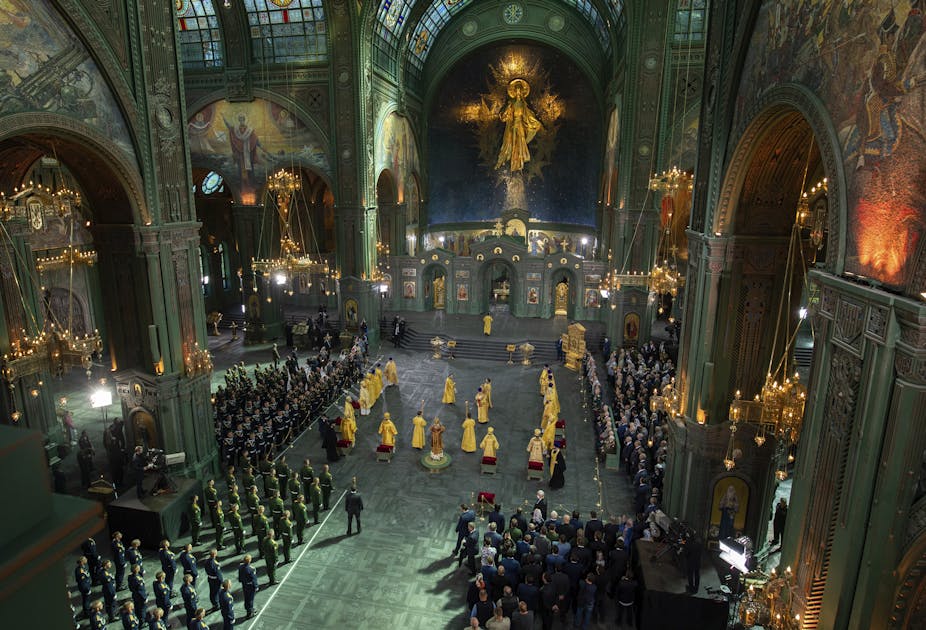
And for that antique Nazist paraphernalia that some Azov members supposedly had... Well, this is the Main Cathedral of Russian forces built in 2020 where they store various Hitler's "relics" (yep, exactly that term - "relikviya" - was used here by the Russian top military leadership!) including his uniform, medals, etc. and where walls and floor is made out of German's tank metal - basically they made a Hitler shrine (and can make a good money organizing pilgrimage here for the neo-Nazis across the world :).
Anyway, Russia is a full blown nazist state today like Germany was in 1939 and whatever Russia says, in particular about nazims, is worthless at best, and usually is just outright propaganda lie.
>the Russian-speaking population in eastern Ukraine and Crimea would ever agree
Definitely nobody is asking that population today. The Russian puppet regimes on those territories are terrorist states just like ISIS - the only difference is that ISIS preferred public beheadings while in those Donbass "republics" they kidnap and torture with fate of many unknown, though few mutilated bodies found so far of such disappeared people suggest that there is no good fate to expect.
>It's important to note that elements in Ukraine si
nce 2014 pushed a series of oppressive legal restrictions on the Russian-speaking segment of the population that were designed to push that entire group into second-class citizen state.
That wasn't push against Russian speaking population. That was push against various symbols of the totalitarian regime of USSR. In particular removing names from public places of the USSR leaders who ordered/led mass killings of millions of people, ie. Lenin, Stalin, and their close associates in that, etc.
The requirement for Ukrainian usage in Ukraine is the same for Russian-speaking as for say Hungarian- or Romanian-speaking minorities.


I would say they already are disempowered. It is unfortunately pretty hard to organize anything when you have to worry about high rent, not losing your job or having to move every few years. What we have seen in the last decades is that it is now hard to do much at all through organizing unless you can somehow affect the economy. Which you can't if you risk getting fired or evicted doing so. Look at Japan, South Korea, Singapore, Hong Kong etc. for the results.