"Think what we please, and say what we think—how better to sum up the happiness of political freedom? And the reverse is pure tyranny."
- A History of Knowledge, Charles Van Doren.
Instead of seeing the bright side of life, in which this person clearly vastly improved their situation in life, all they can see is what they don’t have.
“I knew I was the only poor person at my tech startup because I had the only fat body in the building.”
I’m sorry, but no, being poor doesn’t make you fat. Your eating choices make you fat. Poor people have agency too. Agency is not something you buy. This is coming from someone who probably makes half of what you make in a year.
There are quite a few papers out there on the subject. As someone who has studied a little bit of sociology, I can tell you there are numerous sociological factors which basically determine that wealthier people have access to better food, better medical care and live healthier lives in comparison to lower-socioeconomic people. Where you live alone determines your health equity, if you live in a remote area or small town away from a large city, your access to fresh and non-processed foods is heavily reduced.
It is also worth noting that it's not necessarily how much money you have that is the contributing factor, it can be other factors. The lack of green areas or pathways to walk/exercise (especially prevalent in remote Australian communities), the number of hospitals or doctors close by. But, ultimately, lack of health services and fresh food are correlated to obesity both of which are determined by your location which, in turn, is determined by your financial status.
> if you live in a remote area or small town away from a large city, your access to fresh and non-processed foods is heavily reduced.
Do you really think this? I know the sticks. You apparently don't. You can live off potatoes, eggs, and oatmeal and not be fat. Those are available anywhere.
There is a "poor" culture, there is an "elite" culture, and then there is a "responsibility" culture. I grew up financially poor in a manufactured home in the sticks, but my culture of my parents was that of "responsibility". Know the difference.
"The Road to Wigan Pier" had a great bit about this, which hits the nail on the head based on my experience being working class:
The basis of their diet, therefore, is white bread and margarine, corned beef, sugared tea and potatoes—an appalling diet. Would it not be better if they spent more money on wholesome things like oranges and wholemeal bread or if they even, like the writer of the letter to the New Statesman, saved on fuel and ate their carrots raw? Yes, it would, but the point is that no ordinary human being is ever going to do such a thing. The ordinary human being would sooner starve than live on brown bread and raw carrots. And the peculiar evil is this, that the less money you have, the less inclined you feel to spend it on wholesome food. A millionaire may enjoy breakfasting off orange juice and Ryvita biscuits; an unemployed man doesn't. Here the tendency of which I spoke at the end of the last chapter comes into play. When you are unemployed, which is to say when you are underfed, harassed, bored and miserable, you don't want to eat dull wholesome food. You want something a little bit 'tasty'. There is always some cheaply pleasant thing to tempt you. Let's have three pennorth of chips! Run out and buy us a twopenny ice-cream! Put the kettle on and we'll all have a nice cup of tea! That is how your mind works when you are at the PAC level. White bread-and-marg. and sugared tea don't nourish you to any extent, but they are nicer (at least most people think so) than brown bread-and-dripping and cold water. Unemployment is an endless misery that has got to be constantly palliated, and especially with tea, the Englishman's opium. A cup of tea or even an aspirin is much better as a temporary stimulant than a crust of brown bread.
>The ordinary human being would sooner starve than live on brown bread and raw carrots.
The only people who think that have a very privileged upbringing. My SO worked in an archaeological site in central Asia, and the vast majority of the hosts meals were just raw onions and stale flatbread.
Not irrational at all. I've often wondered at some ascetic values of the very rich: cold showers, building a cabin with your own hands, short duration of rough wilderness living, and in your quoted case, abstemious diet. Humanity spent generations trying to escape those conditions, poor people will never willingly engage in them. Is it because the rest of rich people's lives are elevated away from those conditions, so it's a choice to embrace it, and thereby redefining the thing's perceived values?
Yet another data point on why the poor are playing the lottery, eating crisps and not virtuously buying and cooking rice and lentil, there's a game-theory-ish idea that the poor understands that as much hard work and lentil they could shovel, they stand little chance of getting out. So with the money they have they buy the best value thing possible, discounted for future possibilities; and those best value things are junk food, lottery tickets, sometimes expensive (relative to their circumstance) and flashy things like clothes or phones.
"if you live in a remote area or small town away from a large city, your access to fresh and non-processed foods is heavily reduced."
This simply isn't true. Most food deserts are in the poorer areas of the cities because nobody is bringing fresh produce in there to sell. If you live in the country or small town, many of these places have farm stands, farmers markets, and local farmers providing seasonal produce to the local stores.
Not to mention, lower density housing generally means that there is enough land to have a veggie garden, depending on the specific circumstances.
Rural areas being chock full of farmers markets is mostly nostalgia, anyone I know who lives in the country is far more likely to shop exclusively at Walmart than anyone in the city, and likely to prefer more non-perishable food (i.e. processed) because daily or multiple times a week shopping trips are infeasible.
The farms in rural areas are generally focused on growing a single thing (either one type of livestock, or all corn, etc.), entirely for wholesale, farmers markets are a distraction for most of them, outside of smaller farms that are more of a lifestyle / hobby thing a lot of the time.
Farm stands sometimes exist, but they're an exception rather than the rule in most places, and unless you're in an area known for growing fruit or something like that (and primarily selling to tourists driving by) it'll be one-off things like sweet corn in season or eggs.
You're both kind of right here. The farmers market stuff is mostly BS.
In the rural areas the weekly/biweekly shopping routine involves everyone (rich and poor alike) dragging their butts to the one strip mall in a 1-2hr radius and that strip mall will have at the bare minimum a super-walmart with a good fresh produce section or a Walmart with a grocery store beside it because that's the place where rich middle and poor from the entire area shop and it needs to cater to them all in order to get them to drag their butts there and do business. The poor will buy less and fill in the gaps with Dollar General food (which is bad food at a bad price).
The poor urban areas which can't economically support supermarkets and who's residents can't economically justify traveling the range they'd need to travel to get to those supermarkets (because the run down not always running cars that underpin the transportation of the rural poor are not as economically viable in cities) so they're stuck buying food at CVS, the bodega or whatever convenience store is accessible.
If you draw the food desert line at "no Whole Foods and no farmers market" then they both suck. But if you zoom in on the area below that the rural areas have a slight edge.
The idea that farmers markets are commonplace in rural areas is mostly BS. They exist in cities for sure, but you pretty much need an urban population (and probably a fairly well-off population) to really support a farmers market.
Just because farms exist in an area doesn't generally mean the people in that area are getting their food from those farmers (at least directly). That's mostly a relic of an old vision of farms that grew every type of produce and had a variety of livestock instead of the corporate monoculture farms that dominate today.
Sure, the truly rural people aren't going to farmers markets, but the people in small towns and suburban areas do (this is in contrast to the "big city" in the original comment). Most rural people use a store for most stuff and then go to farm stores/stands/neighbors for other things.
There are still farms that produce a variety of produce. Many of them only produce them as a small percentage of their operation. For example, the dairy farm down the road plants sweet corn, tomatoes, peppers, watermelon, cantaloupe, and (not food, but) manure. I know of several other farms that do similar things.
"because daily or multiple times a week shopping trips are infeasible."
Do they not have a refrigerator? Once per week trips (maybe even less) were the norm for me growing up, and I had plenty of fresh fruits and veggies.
I've lived in multiple rural areas. Yes, many people do get food from Walmart. I can see some of the more remote people preferring some processed food. I can also see those remote people growing and processing their own (canning, like I do). Many people use frozen veggies, which I don't consider processed and are nearly as good as fresh. Most of the "fresh" stuff you see is actually months old due to the way the supply chain works. It arguably loses as much or more nutritional value than the frozen stuff. This situation is completely different from the actual food deserts you get in the city. The rural people have the option to buy fresh but may choose not to. These people living in food deserts in the city don't have the option of fresh produce in the stores they go to. They generally don't have space to grow their own either. This lack of choice is the big issue.
Every area I've lived in has had farm stands and farmers markets. It has also had local stores that contract with local farmers for seasonal produce. Individual vendors/farmers do tend to have limited selection by focusing on one or two crops. But there are usually multiple farmers focusing on different things (and coordinating through the local grange). Yes, the majority of farms are monoculture soy or corn. These other farms are usually 90% that but maybe 10% other crops, like pumpkin, corn, watermelon, tomato, cantaloupe, onion, potato, honey, hops, etc. There are also CSAs that you can join for a variety of produce, including meat and dairy. My parents live in an area where the local dairy still has delivery service - that's right a good old fashioned milk man.
> Do they not have a refrigerator? Once per week trips (maybe even less) were the norm for me growing up, and I had plenty of fresh fruits and veggies.
Yeah, I think we're agreeing - I'm saying that going to the grocery store once a week or less is probably going to result in purchasing a smaller percentage of fresh produce (certainly not none, but for meats in particular any less than once a week is starting to get sketchy in terms of keeping things fresh when refridgerated.)
CSAs for sure exist, but I see way more usage of them in urban areas. You're certainly not prevented from using them in rural areas (although delivery might not be available and pickup might be far less convienent than it would be in an urban environment).
This might be a function of where we're from, but in the countryside here hobby side farms by actual farmers are relatively rare and usually aren't producing enough to be considered much more than an in-season treat. I've never heard of milk delivery still being a thing (despite knowing a bunch of people living on farms), so I suspect you just have a different regional experience.
> The farms in rural areas are generally focused on growing a single thing (either one type of livestock, or all corn, etc.), entirely for wholesale,
And most of the farms are not only going to be growing just one thing, but the same one thing as other nearby farms (of which there won't be very many, since farms have been consolidating into ever larger operations for many decades).
I grew up in a rural area and I think I can count on 1 hand how many times I saw a farm stand. People do not shop at farm stands and farmers markets in rural areas that often.
I'm in a very small town right now and it's a reasonable driving distance from farms. It looks to me like the average farm stand is simply some clever person buying crates of produce at the wholesaler.
No shortage of healthy food at the local grocery stores of course.
I expect that people who wave their arms about 'food deserts' could probably stand to visit either small towns or urban areas and form an opinion based on actual experience.
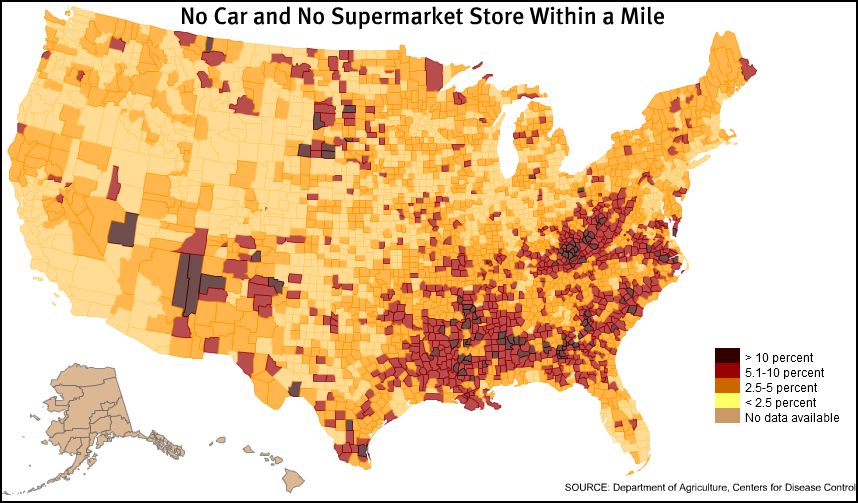
Conjecture here because I don't honestly know, but I think some of what you're observing might just be that food deserts are very regional. If you look at this image [1] you can see that it's basically just the Southeast/Appalachia. Rural Midwest, West, etc don't seem to have this issue nearly as much.
>ost food deserts are in the poorer areas of the cities because nobody is bringing fresh produce in there to sell.
Talking about things that simply aren't true.... Every major city in the US has a large farmer's market present and typically more than one happening in neighborhoods all over the city. These cities also have free/cheap public transportation to get people to the farmer's market. Additionally, you don't need a farmer's market to obtain healthy food, supermarkets are just fine.
The is just trope along the same lines of black people can't get their own ID's or figure out the internet. It's an incredibly racist way of thinking. They're not stupid or incapable people. If they want to they can certainly obtain healthy food.
"The is just trope along the same lines of black people can't get their own ID's or figure out the internet. It's an incredibly racist way of thinking."
I never said black people. That's your own bias talking.
I agree that people can travel to a supermarket (and that supermarkets have healthy food). It's much more difficult to take a weekly trip for a family's needs in public transportation as opposed to loading up a car. More frequent trips tend to incur higher opportunity cost due to the commute times.
IDs are a completely different matter. The need for those trips are about once every 4-6 years and generally lower expense too.
>I never said black people. That's your own bias talking.
I made a comparison to it being similar, I did not say it exclusively affected black people and this is why I used the terms "along the same lines". Reading comprehension please.
>It's much more difficult to take a weekly trip for a family's needs in public transportation as opposed to loading up a car. More frequent trips tend to incur higher opportunity cost due to the commute times.
I disagree. All the elites and hipsters in big cities live this way on purpose so it can't be that hard. I find it ironic that the same people who push for more public affordable transportation will turn around and say it's too hard to use and personal transportation is better when it comes to minorities. Additionally, if we follow your logic then rural people are vastly more affected by this than anyone living in the inner-city since they have to travel much longer distances and don't even have public transportation available.
It's normal and cool actually that we can take something that affects a MAJORITY of Americans and is tightly correlated to poverty and make it a matter of individual responsibility and moral weakness.
It only counts as moral weakness if you're blaming your own obesity on somebody other than yourself. Most people people who are fat are quite happy with eating a bunch of junk food, so they just have different priorities.
If you have have access to $1 frozen veggie bags, $2/lb chicken thighs, and assortment of different legumes, you have it better food options than the majority of the world. You can certainly achieve a healthy diet if you really want to.
It is correlated, not caused by poverty. Rich people are often fat too, and the reason is poor education (not even rich people schools teach this) and poor self-control.
It’s not just food education. If you’re poor in the US you’re much less likely to live near a source of fresh meat and produce, which makes calorie-rich fast food more tempting. You’re more at the mercy of many multi-billion-dollar industries that serve unhealthy food to the masses.
There's an opportunity cost and a time cost (and an attention cost) to making food properly and eating right.
Opportunity: if your area cannot give you produce (raw materials to cook with) that's pretty direct. Time: I'm fortunate enough that I can blow at least an hour a day just cutting up meat for stir-fry or preparing my omelet and oatmeal, and a lot of this is really time-optimized but it's still way more than the microwave-box lifestyle. That hour (at least, and distributed among all my meals for the day) is also an attention sink that I can't skip, even though I make the same stuff over and over. If I couldn't do that, I'd have to not only be getting different foodstuffs, but also figuring out different recipes every time I got bored.
You can let corporate America do that stuff for you and just pick different enticing boxes of microwaveable stuff, but you will get bombed with combinations of sugar and salt because competing in the supermarket aisle is serious business and those who fail are lost. They'd be putting fentanyl in the Hot Pockets if they dared. Anything to make the sale, it's that or perish.
Then, that's what you eat, if you're poor and can't spend hours doing it yourself and doing it right. And if you're poor enough… the selection at Cumberland Farms is going to be strictly kept to whatever the other poor people in your neighborhood are addicted to, because that's what will sell.
I'm from a developing country where these things are affordable and less wealthy people spend money on cigarettes rather than salads. Here it definitely isn't about money but about having proper food culture
I'm not particularly interested in some "studies" that come out with statistics saying its hard not to be obese when poor. The fact of the matter is that it's possible to eat relatively healthy affordably (e.g. rice, potatoes, food on sale/discount), and that if you were truly poor you should be saving money by eating less food.
Or your assumption wrong. Here is a reasonable explanation: People are poor since they got bad self control, which also makes them fat. People who lack self control are easily tempted with shitty fast food, so their areas mostly serves it rather than real food creating these "food deserts".
If there was demand for food in those areas people would sell it, but there isn't.
Edit: A strong piece of evidence is that people aren't getting poorer, but they sure are getting fatter.
If we're talking about the obesity rate, statistics make it clear that it's easy to be obese when poor, not that it's not easy to not be obese for the poor.
Or are you talking about statistics that asked if poor people tried to not be overweight but couldn't do it? If so, could you please send link to that - as I'm not aware of any such large-scale study and quick search didn't reveal anything significant?
If it's not hard to avoid being overweight when poor, and most poor people are overweight... what is happening? Do you see the obvious conclusion here? Do you endorse it?
People are getting fatter and fatter. It is much worse now than 20 years ago, and even much much worse than 40 years ago. Any explanation you can come up with needs to be able to explain this as well. Does poor people have worse access to food today? Do they have less money for food today?
If we put poor people in the same conditions they had 40 years ago they would be slimmer than rich people today.
Over the past 30 years, grocery store prices have risen 4.5 percent above economy-wide prices, indicating that food has become relatively more expensive than some other consumer goods... Real prices for fresh fruits and vegetables grew the most among all major food categories, increasing just over 40 percent... Over the same time period, real prices for fats and oils, sugar and sweets, and nonalcoholic beverages grew less than overall inflation.
Yes I know where you stand on this, I don't need more information about your opinion.
I asked if you see the conclusion of this view, and if you endorse it.
To be very very clear it goes like this: if poor are fat because they make bad choices and for no other reasons, then you can reasonably conclude that that is also why they are poor. That they deserve to be poor for that reason.
As someone who does not live in the US, it is often discussed in my social circles. To us, it appears that this cultural propaganda is a political necessity to stay far from communism. The cultural conception of the extent of the free-will impacts notably justice (individual responsability vs. psy impact of the environment) and wealth redistribution (welfare vs. meritocracy).
The conception that most of the bad things that happen to an individual is because of poor choices makes perpetuating inequalities easier. Notably thoses that stem from free market capitalism.
In France we have a strong cultural awareness of our low/inexsitent free-will. This translates readily into state welfare.
There are food deserts in the USA, where you literally can't buy high quality food like vegetables in a large area, and have to resort to only eating the highly processed and highly unhealthy food. These food deserts usually are located in the poorer neighbourhoods.
Which supermarket chains in the US do not provide vegetables, fruit, meat and only offer processed food? Please find us a 'food desert' where there are no supermarkets nearby.
This is a myth that's easily refuted. There's an argument to be made that poorer people aren't educated on healthy food choices but the idea that they don't have access to anything but processed food is just silly.
Food deserts are a big problem. Most of the urban food deserts developed after major riots burned down existing grocery stores in the late 60s (and then again in the 80s in LA).
New food deserts now exist in Minneapolis (and likely other cities as well) after the recent rioting and burning there:
Ironically, in the most recent riots, many - perhaps most - of the destructive rioters were middle-class "activist" kids who don't have to live with the results of their actions.
But junk food is less filling and satiating than real food and much more dense calorically. You can eat lettuce all day and never consume the number of calories in a fast food burger.
> Being 'underweight' is associated with significant excess death; being 'overweight' is associated with a lower death rate than 'normal' BMI:
This is nonsense. In many medical deaths such as cancer (and especially since euthanasia isn't available) the person dies by slowly withering away. One of the first things that happens is that they become skinny and frail. That doesn't associate underweightedness with mortality. It intentionally draws a false correlation.
However, it doesn't explain why being 'overweight' BMI consistently proves to be protective against death, despite it being so stigmatised that it affects quality of medical care.
> However, it doesn't explain why being 'overweight' BMI consistently proves to be protective against death
I don't see how the "protective of death" conclusion is able to be maintained when it was determined by comparing the mortality of overweight people to frail and dying old people and cancer patients. The reality is that it's the opposite. It's well known that being overweight damages the organs and makes a person more susceptible to dozens of diseases.
I said "relatively slim". I actually meant by that a bit of a tummy, but not morbidly obese. I'm not recommending six packs for all. God knows I don't have one.
Also, being "overweight" could be for a variety of reasons, including excess muscle. I'd be interested to see mortality correlated with % body fat.
Obesity is significantly correlated with lower income. However, in an individual case it is not sufficient to draw conclusions.
Edit: also you seem to present the author's formulation as meaning that they believe poverty caused them to be fat. As far as I can tell she is merely pointing out a series of correlations to both prove that she, in fact, stood out as poor, and to show how this distinction affected her furthermore. Btw I'd say the only actively harmful behaviour from the company she pointed out was making her suggest a salary rather than them making an offering.
Exactly my thoughts. This person just wants to make herself feel good about victimizing herself. Justifying unhealthy behaviour and habits by being poor earlier in her life? Come on. Yes, some of her colleagues seem to be on the other extremes, but many of her examples are just ridicolous. Eg: adult soccer leagues are one of the cheapest activities I can think of, besides running (which is also done by "rich" people).
I'm also coming from a poor family and area, and I also had a few revelations, but nothing like this. My very first of these experiences was at a company paid dinner, where the waiters rolled out a trolley of beverages next to our a table and went away for a couple of minutes. I joked to my colleagues at the table that we could just steal that trolley and nobody would notice it. Nobody laughed, of course and I realised that at that point in my life I could buy a truck of those beverages on my hourly wage. That was nearly 3 months into my career and I just moved on right away.
I must say I was rather triggered by that statement. I'm 100% sure that at one point my earnings were much lower than hers and I wasn't "a fat body". I had a second hand road bike that consisted of many different parts and I loved that thing, I've put thousands of kilometers on that old frame. And guess what, I still use it to this day, even though I could buy a fancy new one.
As a matter of fact, not having a lot of money only emphasizes the fact that your health is one of the things you can influence.
We never had much money, but we ate well. And I ate a lot, but I was also very active. Being active is free.
I know this will upset people, but if poor people are fat, food is not scarce. The quality of food may be low, but low food quality does not make one fat, a surplus of calories does.
To be absolutely clear, I know there is a strong correlation between socioeconomic status and obesity. It's much more complicated than "just eat less", many factors play into this. Including food IQ. It's much more easy to overeat on Cheetos than it is on potatoes and green beans. A persons social environment will have a big influence on how and what they eat, how much they will move, etc.
Low quality food absolutely can make you fat because it makes it harder to eat properly. Unhealthy food isn’t just “easier to overeat” but also messes with insulin to make you feel more hungry than you actually are.
Because statistically poor people who remain poor have poor impulse control, prioritize short term pleasure and make bad decisions. Like many people who escaped poverty, I am not poor because lacking these traits elevated me out of poverty.
The last 20 years has probably made (much) less difference than you appear to think.
From Wikipedia: "The rate of increase in the incidence of obesity began to slow in the 2000s".
But, to attempt to answer your question:
e.g., the expectation that both adults in a household will work means that people/parents are more likely to be time-poor and not able to cook. Cooking skills have been lost.
> Instead of seeing the bright side of life, in which this person clearly vastly improved their situation in life, all they can see is what they don’t have.
I think there is a self-deprecating humor to the article, and I enjoyed it. Life in tech world is strange sometimes.
Everyone replying is saying various things about how it's not the poors fault that they've been taken advantage of and have crappy food options and that's why they're fat.
They might be right about the bad food options but what these people don't get is that if you're poor you have a lot of bigger more time pressing, more tractable problems to solve than being fat. Most of these people would still be fat if they had more ready access to "good" food because good food wouldn't magically make being fat jump to the top of their priority list.
When you have little money you can very easily justify skipping lunch everyday or something like that. Skipping breakfast or lunch, having a very minimal meal for the one you don't skip (think PB&J, maybe with a fruit cup if you're feeling like a high roller) and then having your big meal at dinner so that your hunger is focused on the parts of the day when you're working and distracted and you go to sleep full is a very, very, tractable form of dieting and cost cutting rolled into one.
But if you have enough money to indulge in food/beer then why not do it, it's about the only luxury you can afford.
This is true in a superficial sense. But healthy food is generally more expensive than junk food. Gym memberships, exercize equipment, personal trainers, and outdoor recreation costs time and money. It's hard to prioritize self-care when you're struggling with the day-to-day stresses of poverty, like how do I get to work after my car broke down for the third time this month. Poverty is stressful and stress-eating is a thing.
Sure, there is no law of physics that makes poor people overweight, but it is much easier to have a thin waistline when you have a fat bank account. And indeed we observe that in the US, poor people are heavier than wealthier people.
The only difference is that if I’m wrong, some people got free stuff but if you’re wrong, people are languishing in despair with little to no lifeline. Are you willing to bet other peoples lives on the idea that your experience is truth? It’s not something I am willing to do; I value human life too much.
Being poor doesn't make you fat per se, but if you look at most stats, higher social levels(whatever that means in each country) usually means less obesity. When I worked in construction, most people were eating an absolute crap and were often overweight. Then I joined a professional services company and I literally walked into an office of 50 or so people, where everybody was slim and most people ate pretty healthy, home made food.
There are lots of factors why that's the case,but to say it's not happening like this wouldn't be right either.
Would it not be better if they spent more money on wholesome things like
oranges and wholemeal bread or if they even, like the writer of the letter
to the New Statesman, saved on fuel and ate their carrots raw? Yes, it
would, but the point is that no ordinary human being is ever going to do
such a thing. The ordinary human being would sooner starve than live on
brown bread and raw carrots. And the peculiar evil is this, that the less
money you have, the less inclined you feel to spend it on wholesome food. A
millionaire may enjoy breakfasting off orange juice and Ryvita biscuits; an
unemployed man doesn't. Here the tendency of which I spoke at the end of
the last chapter comes into play. When you are unemployed, which is to say
when you are underfed, harassed, bored, and miserable, you don't want to
eat dull wholesome food. You want something a little bit 'tasty'. There is
always some cheaply pleasant thing to tempt you. Let's have three pennorth
of chips! Run out and buy us a twopenny ice-cream! Put the kettle on and
we'll all have a nice cup of tea! That is how your mind works when you are
at the P.A.C. level. White bread-and-marg and sugared tea don't nourish you
to any extent, but they are nicer (at least most people think so) than
brown bread-and-dripping and cold water. Unemployment is an endless misery
that has got to be constantly palliated, and especially with tea, the
English-man's opium. A cup of tea or even an aspirin is much better as a
temporary stimulant than a crust of brown bread.
Yes, but before that excerpt Orwell pointed out that the financial margins involved in eating healthily on the minimum income were much narrower than the "why don't they just" contingent knew or admitted. That doesn't carry over to the contemporary US as self-evidently as the psychological point does, but I suspect that it does carry over somewhat.
I do encourage anyone who hasn't already to read the whole chapter http://www.george-orwell.org/The_Road_to_Wigan_Pier/5.html : it's not really very long though I felt that the relevant parts were a bit too long, all together, to fit in a comment.
I'm glad I didn't read that book when I was still "poor", it's so relatable and hits hard. I recommend it for anyone kind of wondering (he's not exactly kind to the working class, but he does try hard to understand it all and does have insight).
Are you suggesting that she chose to be employed at a start up and is actively choosing to stay there because it's a worse situation than she had before?
> Instead of seeing the bright side of life, in which this person clearly vastly improved their situation in life, all they can see is what they don’t have.
First, I dont think this accurately describes the list at all. Second, it is ok for people to express negative feelings or observations. Forced positivity is toxic.
Facebook this week appended a Wall Street Journal op-ed “We’ll Have Herd Immunity by April” by Johns Hopkins surgeon Marty Makary (Feb. 19) with the label “Missing Context. Independent fact-checkers say this information could mislead people.” According to Facebook, “Once we have a rating from a fact-checking partner, we take action by ensuring that fewer people see that misinformation.”
The question is, how did this start just now? In 2020? How is the COVID-19 vaccine the first to use mRNA? Anyone with who has taken AP Biology could conceive of and understand the idea behind making vaccines rapidly: take some mRNA, inject it, have in translated as the antigen in the body. Poof, that's it. I feel like the development of mRNA drugs should have started in the 70's or 80's. It isn't exactly high-tech or clever.
Delivery of the RNA is hard. To the right cell type, not immediately degraded, not accidentally integrated into a critical part of the genome, with a payload that is actually effective, etc.
The original gene therapies (early 2000s) were essentially RNA therapies (adenovirus). And their unethical rush and subsequent failures caused a bit of a 'gene therapy winter' [1]. We've since made enormous progress on both the ability to safely deliver genes, but also our ability to generate/design new useful genes.
> In 1972, a paper titled ‘Gene therapy for human genetic disease?’ was published in Science by US scientists Theodore Friedmann and Richard Roblin, who outlined the immense potential of incorporating DNA sequences into patients’ cells for treating people with genetic disorders. However, they urged caution in the development of the technology, pointing out several key bottlenecks in scientific understanding that still needed to be addressed.
"incorporating DNA sequences into patients’ cells" is a wildly more dramatic approach than temporarily tricking a number of cells into manufacturing some protein with mRNA. It's almost like the difference between getting the browser to run your page's js vs a full remote code execution vulnerability.
The parent was probably confusing RNA with adenovirus which IIUC does deliver DNA that integrates itself into the genome. There are dozens of COVID vaccines under development right. Many of them are in fact DNA vaccines. To date they've only been approved for vaccinating dogs of rabies. The mRNA vaccines that companies like Pfizer are making have the advantage of not permanently changing the DNA in the target cells. Even with DNA vaccine it's not the end of the world. For example, herpes simplex (cold sores) is an example of a natural virus that integrates itself in the DNA. But it's localized and it's not something that your children are going to inherit. Another interesting fact is that the Pfizer mRNA vaccine and others are delivered using lipid nanobots rather than adenovirus which I think is cool. But DNA vaccines have even potentially cooler applications since it means the medical field might for once be able to offer cures to illnesses, rather than charging you for a pill every day.
The number of [nucleic-acid-delivered] gene therapies in Phase II & Phase III trials right now is huge - because of this progress in delivery [of nucleic acids]. Gene therapies for the eye, for hemophilia, for sickle cell, many many cancer therapies all rely on the ability to 'deliver' nucleic acid payloads to cells. Of those, only 3 or 4 have been approved - and all in the past 2 years, but there are a huge number that are behind that tip of the iceberg - quite precisely because it's relatively straightforward to do 'same thing but with a different sequence' once the first one works.
The technology for synthesizing large quantities of specific RNA sequences has only been available recently. Same goes for forming the lipid nanoparticles that are used for encapsulating and delivering the mRNA. In fact if anyone has more detailed information on how these two processes are done I would love to learn more.
the emphasis in the wiki article is on DNA, the same basic principles apply with RNA.
for example you can start with RNA and use reverse trancriptase to produce a DNA sequence, amplify that sequence to a large copy number by repeatedly replicating it then transcribe the DNA to produce large quantities of RNA.
or you can start with the DNA [in large quantities of purity] then create many copies of the RNA by repeatedly transcribing the DNA.
The practice of artificial [in vitro] gene synthesis can create arbitrary sequences for input to the process[es].
> the emphasis in the wiki article is on DNA, the same basic principles apply with RNA.
This is not my understanding. PCR works to produce DNA because the DNA polymerase enzyme creates DNA copies from DNA templates, and those copies become templates themselves, feeding back into the chain reaction.
I'm not aware of similar enzymes capable of making RNA copies from RNA templates (RNA polymerases use DNA templates AFAIK).
I was imagining the RNA vaccines would have used a fully synthetic oligo production method, to get the extreme purity required. But it might be that some sort of PCR-like amplification process is used. Would love to read more if someone has details.
I was making reference to the process of cyclic amplification, in a manner palatable to non biology literate individuals
The same _basic_ principles
as can be read in the chempedia example the process of RNApol replication of RNA from RNA template is error prone, thus it is superior to create a large copy number of DNA template corresponding to the mRNA desired as DNA amplification is self correcting for the most part.
dependent upon experimental or procedural requirements it may be desirable to produce error prone replication variants of the RNA template, however it is quite possible to go from RNA template to RNA product with RNApol.
due to the fragile nature of RNA there must be some shielding or , a low cycle rate is used in conjunction with immediate harvest and stabilization of the product.
the sars-2 covid19 virus replicates by way of an RNA dependent RNApol [rdRNApol]
Thanks for the additional links. I guess you would need temperature stable viral RNApol to do direct 'RNA' amplification. Not sure if that exists or if it's even possible due to RNA instability. As you say not so worthwhile due to high errors.
Producing RNA from DNA amplicons (PCR products) makes sense, I'm curious if that is the source of material from in the vaccines, or if it's artificially synthesized?
when you have determined a sequence of RNA corresponding to a desired protien you may construct a DNA template with modification to suit your purpose.
the DNA polymerase used for DNA PCR is originally from a high tempurature tolerant organism, [thermophillic bcterium] and it is possible via searching high and low to find an organism that bears high temperature tolerant rdRNApol
Thanks for the Kary Mullis story. I performed thousands of PCRs and even made some batches of taq many years ago but never knew about its ideation! I knew some pretty out there biochemists though.
I'd like to know more about the potential for lipid nanoparticles to cross the BBB [1], and therefore consideration of long-term effects of mRNA and resulting proteins in brain cells. Am I alone in this concern? [1] https://pubmed.ncbi.nlm.nih.gov/29886842/
You’re right, we’ve understood that this could be done for a long time. Not quite the 70s, but.. at least the 90s. But believing something is possible and knowing how to do it are different:
“2005 they published a joint paper that solved one of the key technical barriers by using modified nucleosides to get mRNA inside human cells without setting off the body's defense system”
That kicked off a ton of research, but:
“Up until 2020, these mRNA biotech companies had poor results testing mRNA drugs for cardiovascular, metabolic and renal diseases; selected targets for cancer; and rare diseases like Crigler–Najjar syndrome”
But why did they spend from 2005 to 2020 working on mRNA drugs and not vaccines? Capitalism. Vaccines are not generally profitable (take once, you’re done) - so vaccines are not an appealing target for a startup with investors wanting big returns. (Source: https://www.statnews.com/2017/01/10/moderna-trouble-mrna/)
Yeah seems like vaccine development only started after the high profit objectives suffered failure. That doesn't mean we can't go back to working on those objectives in the future but they needed SOMETHING that would work to show mrna promise. Vaccines you only have to take once or twice so the side effects of immune response aren't too bad and you have an immune response to a vaccine anyways.
Even for the staunchest capitalist, covid has clearly outlined that we need medical research that is separated from market forces. After sars 1 was controlled, research in this area was all but dropped - despite virologists warning that it was just a matter of time before... well, this.
Medical research needs to be driven by what can help people, not by what can make the most money.
PPE too. We still don't have N95s for the public or in some areas even the medical professionals.
If we had a different administration in the USA we may have been able to conquer that quickly with sheer cash and coordination since the knowledge how to build melt blown N95 machines is there. For whatever reason we just didn't.
The immune system is incredibly dangerous to its own host if mishandled. By stimulating response, you are trying to light a cigarette using a white phosphorus flamethrower, so to say.
It took a lot of time to find the optimal way of mRNA delivery that a) really does something but b) does not provoke a massive, counterproductive response. This is a very narrow rocky ledge with precipices on both sides to walk.
I think the theory behind it is straightforward enough (and indeed, Moderna was founded 10 years ago with this sort of mRNA vaccine as their explicit goal), but the practice is more complicated.
Figuring out what sequence of mRNA will be the right one to get a cell to produce the right antibodies for the job, getting that sequence sliced out of the viral RNA, getting that all into a form where it can be absorbed by cells and not just instantly degrade are all nontrivial tasks.
The devil’s in the details: compare to the field of software or cpu engineering... seems straightforward enough to just have more instruction decoders, but due to complexities only ditching x86 has actually made it possible for Apple to do this.
> Anyone with who has taken AP Biology could conceive of and understand the idea behind making vaccines rapidly: take some mRNA, inject it, have in translated as the antigen in the body.
There was quite a lot of development on basic techniques of working with RNA necessary before that could even in isolated circumstances be easier than, or even competitive with, “isolate the antigen, inject it, done”.
> The question is, how did this start just now?
It didn't.
Getting a treatment to market isn't the start of application of a new technique in medicine; its usually something that happens many years, often decades, into work using the technique.
Given that Moderna is the first ever company to bring such a vaccine to market and they’ve been working on mRNA for the past 10 years, I imagine there’s a lot of technical complexity to actually deliver a therapy and then mass produce it beyond just the basic concept.
Reading how Pfizer and Moderna worked on it together, they needed detailed gene sequencing to understand how to design a potential vaccine. Even then they were left with a lot of potential options they still had to whittle down. Finally even with all that work they’re left with a vaccine with complex storage requirements.
So it’s entirely possible that we just didn’t have the surrounding technical ability even if theoretically it was possible. The gene sequencing to sequence it quickly and share that across the entire world, the compute needed to do try different experiments at scale, the manufacturing capabilities, Moderna having invested in the space for the preceding 10 years, existing experience with developing a SARS vaccine, etc.
Moderna's vaccine is a great deal easier to store than the BioNTech/Pfizer vaccine (requires 'normal' freezers for storage, can be at refrigerator temperatures for a longer period).
BioNTech and Moderna both have links to Katalin Kariko so while they didn't explicitly work together on this the knowledge comes from similar research and sources.
I really honestly think there's something to this. Playing with others in VR has such a different feeling. I was once in a game where the whole team got blown up by a grenade, and then the next game we're all friends joking and laughing with each other in the kind of way that has never happened to me in a pancake game.
“Many hypotheses proposed by scientists as well as by nonscientists turn out to be wrong. But science is a self-correcting enterprise. To be accepted, all new ideas must survive rigorous standards of evidence. The worst aspect of the Velikovsky affair is not that his hypotheses were wrong or in contradiction to firmly established facts, but that some who called themselves scientists attempted to suppress Velikovsky's work. Science is generated by and devoted to free inquiry: the idea that any hypothesis, no matter how strange, deserves to be considered on its merits. The suppression of uncomfortable ideas may be common in religion and politics, but it is not the path to knowledge; it has no place in the endeavor of science. We do not know in advance who will discover fundamental new insights.”
Your quote doesn't even make sense here since they're not suppressing his COVID ideas. Regardless, the scientific community considered it and responded: https://www.johnsnowmemo.com/
While I'd agree that he took some controversial and unpopular positions, I don't think it's accurate to say: "the scientific community considered it and responded". The John Snow Memo was not a specific reply to Levitt's ideas, and I am not sure what the 'scientific community' is. That memo had a relatively small number of signers, so claiming that they represent any large and diverse community is a bit hyperbolic.
From the abstract: "We demonstrate a range of pre-existing memory CD4+ T cells that are cross-reactive with comparable affinity to SARS-CoV-2 and the common cold coronaviruses HCoV-OC43, HCoV-229E, HCoV-NL63, or HCoV-HKU1."
1. Populations may naturally have a head start towards herd immunity from COVID.
2. Sweden could be really close in that regard; their current super low daily mortality and declining cases may point towards herd immunity.
I wouldn't call it "super low" mortality when the average for the past month since the large drop is still 25x that of Denmark (i.e. nearly our neighbors montly totals per day), when it should be more like 2x based on population sizes (and Denmark being denser populated on top of that).
The interesting observation is the relation between the highest death rate (100/day) and current very low death rate of zero to a couple per day 2. This is without significant change in policy, mask use etc.
It’s hard to measure behavior but nothing suggests people have less contact now than in March (more contact is more likely, but on the other hand it’s now more contact outdoors compared to spring).
Writing from Sweden: people were scared in March, now they're relaxing. We'll see what happens in autumn when everyone is back to work and spends their time indoor
There isn’t much talk about easing but I suspect the visitor restrictions on elderly homes might be lifted as soon as possibly since 6 months without being able to visit is a long time. Also the 50 person event restriction is being reviewed. It’s a bit inconsistent to allow 100 people in a restaurant or bus but not 51 people in Sweden’s largest football stadium that seats 50k...
Spectators for kids sportS outdoors also becomes allowed I hope. Having parents watch a children’s game outdoors, for example.
General easing of the last restrictions would be e.g allowing full stadiums for sports and concerts but that is not going to happen this year. The authorities recommend working from home for the rest of the year so that gives some indication about other restrictions. Travel recommendations are easing now but obviously change quickly.
OWID's UI/UX is definitely not my favorite (try to highlight a particular country's line in a graph) but their worldwide data quality appears to be the best right now compared to alternatives.
Current daily deaths in Sweden are averaging about 4 per day continuing to trend towards 0, vs the 0 or 1 per day in Denmark or Norway. If you're trying to argue that 0.38 per capita vs 0.05 per capita is relevant when the gross numbers are so low I'm not sure what to tell you to convince you otherwise.
You look over a longer period of time. Like 25x Denmark for the past month, where that includes a delay of up to 28 days for a death to be reported, and only a few days delay in Denmark.
That was the usual way at least, I doubt that will be seen as the way post Covid. If we learned anything it’s that it doesn’t paint a full picture.
I also doubt Sweden has 10% infection (As measured by serological tests) but most larger cities probably do. Where that puts immunity no one knows. It seems to be enough (for now, with mitigations in place).