Now imagine how the international community feels about the US starting a war of aggression against Iran without even consulting with its allies and trading partners beforehand.
The whole situation further isolates the US globally (they were already isolated before the war due to threats of taking Greenland, making Canada the 51st state, leaving NATO, etc.).
How do you know allies and trading partners weren’t consulted? Of course they were! The US had to get overflight permission the first day.
Iran had long been a thorn in the side of Europe and the Middle East countries. There is no love lost if the US decides to attack Iran. Most US allies would welcome deposing the current Iranian regime.
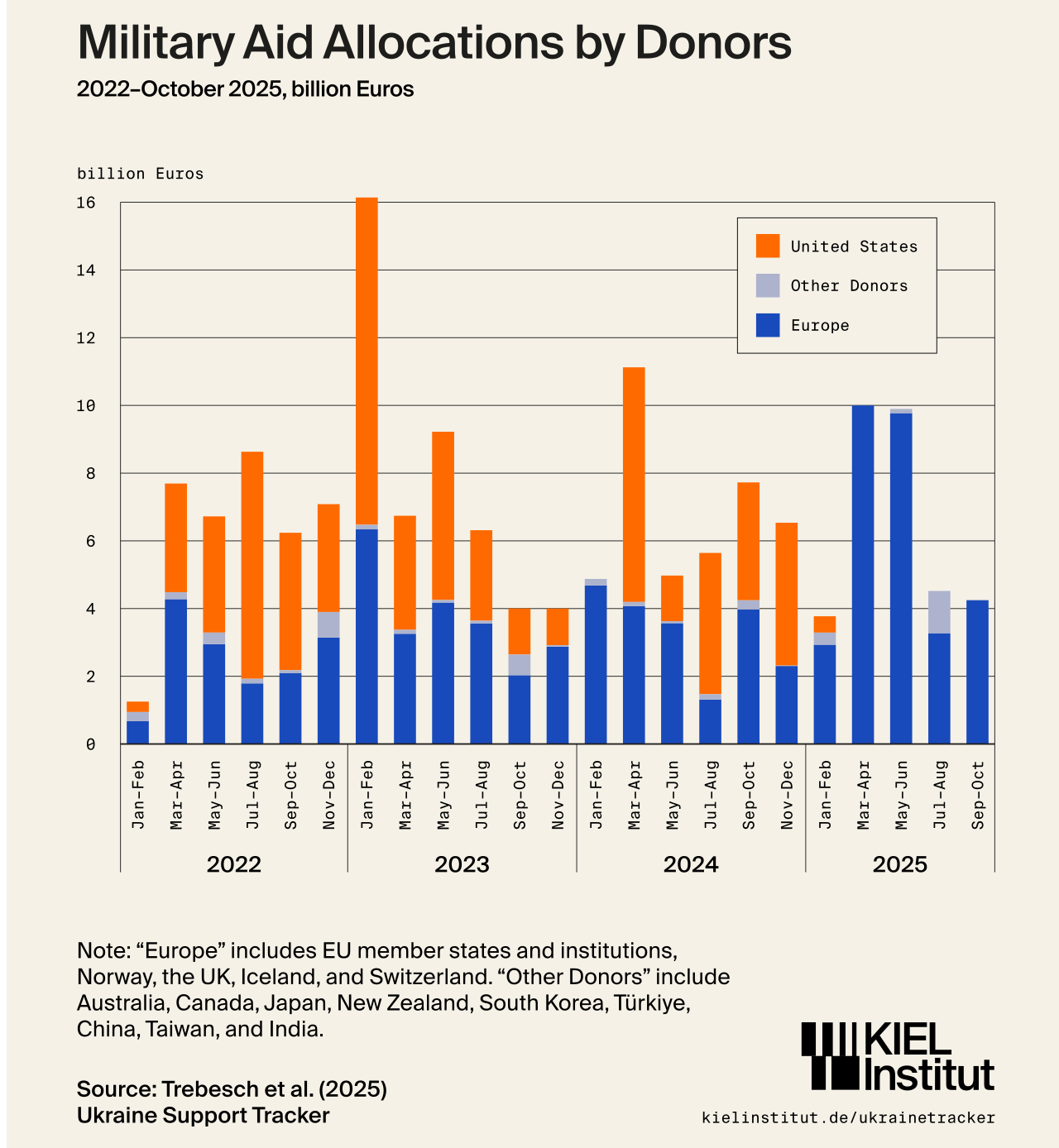
The US is anything but isolated. Notice how happy Europe is now that the US is bankrolling the Ukraine war?
Don’t confuse public statements intended for local consumption with what’s happening behind the scenes. Countries will happily talk tough to keep their own people happy all the while partnering behind the scenes.
> Notice how happy Europe is now that the US is bankrolling the Ukraine war?
The US is not currently bankrolling Ukraine in the way it was in 2022–2024. Under Donald Trump, no new large aid packages have been approved, and support now largely consists of delivering previously authorised funds and equipment.
mopsi provided a link to data. Please at least look at it before making unsubstantiated statements. It clearly shows that the US has not contributed since the beginning of 2025, let alone 'bankrolled' it.
Putting aside the fact that the humanitarian disaster you envision would not produce the simple result you expect, it's quite disturbing that you have completely glossed over the fact that destroying Iran's ability to produce electricity is a war crime.
Committing an act of genocide against a country of 90+ million people would be the death of the US as we know it.
Ah yes, a comment from the morality police. According to international law, if the electrical grid directly enables Iran's military, then it is a valid military target. In every major conflict since WWII, electrical infrastructure has been targeted. This includes WWII, the Korean war, Vietnam War, Iran-Iraq War, the Gulf wars, 2003 Iraq War, and the Russo-Ukrainian War.
So no, it's not automatically a war crime, it's a case-by-case basis.
And claims of "genocide" from are laughable and ludicrous, the target is the IRGC, and regime change. If they wanted genocide there are far more effective ways to do so.
This is a textbook definition of terrorism. That the military uses the civilian infrastructure is a justification that not even the US tried to use. This is pure terror bombing, and they admitted as much.
> According to international law, if the electrical grid directly enables Iran's military, then it is a valid military target.
This is not what international law states. The Geneva Conventions forbid direct attacks on civilian assets. Where assets are dual-use, the principle of proportionality applies and your intent cannot be to cause suffering, destroy civilian morale, etc.
I think anyone with an ounce of human decency and who isn't playing keyboard warrior saw Trump's threat to destroy "a whole civilization" for what it was, which is why so many military and legal scholars were disturbed by it.
For those who actually care about what the law says instead of beating their chests:
Russia bombing civilian infrastructure does not make it "not a war crime". The fact is, USA and Israel did committed war crimes here and planned to commit more of them.
And yes, according to international law. No, you do not get to bomb desalination plants, eletricity plans, universities, hospitals, bridges and schools and claim "it is not a war crime because soldiers in area exist".
It is not possible to take your moral high-ground "war crime" argument seriously, when Iran is doing the exact things you are accusing Israel of doing.
> I'm no fan of this administration but another way to look at things is that the US can essentially destabilize a region while facing mild commodity price increases.
Oil spiked over 40% at its peak and US gas prices are up 25-35%, and that's before things got to the point where there were "real" supply issues. I don't know how you can reasonably consider this "mild".
> Actually it shows that the US could eliminate the leadership at its leisure even if it can't hand select the replacements.
Everyone and their brother has known that the US can assassinate virtually any world leader if it really wants to. The question you haven't answered is: to what end?
> I'm also not sure the powers that be in the ME hate the rising oil prices.
Notwithstanding the fact that this situation only increases the attractiveness of oil alternatives, you're missing a few points, including:
1. If oil prices rise too much, too fast, it leads to demand destruction. Nobody captures the higher profits for long because the global economy falls into recession if oil stays above a certain price point.
2. Price stability is just as important as price.
3. Significant long-term damage was done to oil infrastructure and Iran demonstrated how easily infrastructure can be effectively targeted despite all of the advantages its neighbors have in terms of American support, American defense technology, etc.
Your comment also doesn't consider the geopolitical costs of this "excursion". The administration's actions have further alienated America's strongest allies (except for Israel) and added fuel to the "America is undependable" fire. This is good news for China:
> China surpassed the United States in global leadership approval ratings last year, as Donald Trump's second administration began its term in earnest, according to a new Gallup survey.
> The polling firm reported Thursday that the median global approval rating for Chinese leadership stood at 36% in its 2025 world survey, exceeding the 31% recorded for U.S. leadership. It marked the first time in 20 years that China's approval rating topped that of the United States by more than 5 percentage points.
If we're being honest, there are no winners in war but since we live in a world that likes to have winners and losers, a loss for the US is a victory for Iran.
Not only has Iran managed to survive being battered by the most powerful military in history, it has:
1. Created a global energy and economic crisis.
2. Effectively demonstrated that it can control the Strait of Hormuz even without much naval and air firepower. In doing so, it showed that the US Navy is not capable of controlling the seas anywhere and anytime.
3. Caused the US and its allies to spend billions of dollars worth of advanced weapons systems (many of which were already in short supply) to defend against much cheaper drones and missiles.
4. Incited Trump to lash out at the European countries that have historically been America's biggest allies, accelerating the trend of America's now possibly irreparably damaged relationships with these countries.
5. Baited Trump into publicly and belligerently positioning the US as a hostile state willing to threaten war crimes/genocide to get its way.
A lot of Iran’s victory simply revolves around Trump being so incompetent. But then again any president with half a brain wouldn’t touch a war with Iran given our negative experience in the region fighting much weaker countries.
I think I broadly agree with you. Even if we accept the premise that it is not a win for anyone in a war ( there are counters here, but lets say that we accept it ), the reputational damage to US is hard to be overstated. I am not entirely certain some of it will be salvaged. That is how bad it is.
I am not a fan of Trump, but I was mostly ambivalent about most of his escapades. He clearly got really lucky with Venezuela and it went to his head.
> These are simply the lies I tell myself to keep on living my life in good faith. I'm not saying this is the right way to do things. I'm just saying this is how I did things. I will do my best to color my advice with my own experiences, but I'm not going to pretend that the suffering and the privilege I've experienced is universal.
It's interesting the author chose to wrote this as "advice" given his awareness of this. There are a number of ways he could have shared this information without presenting it as "advice."
This right here, this is it. You've nailed the reason I stopped caring about what Trump is destroying. Yes, yes he's destroying gestures wildly at everything -- but god dammit we need to destroy a lot of this stuff. We need to rebuild institutions that have failed us, from your local DMV and/or public school all the way up to Congress, the Supreme Court, the Executive.
All of it has been so thoroughly corrupted that it needs to be destroyed and recreated.
Yes, once the orderly destroying is done, the sensible people can step in and recreate these institutions from scratch while everyone else waits patiently.
Or, everything just gets way worse, for almost everyone.
> Yes the US probably is still using precision weapons because, well, unlike the Iranian government we don't want to use so-called dumb munitions and indiscriminately bomb civilians or civilian targets.
Are you referring to the "precision" weapons that hit the girls' school?
> Frankly, these are very good lessons learned by the United States and they're going to come in handy if we end up in another war.
This is an interesting take given that the US seems to have ignored many of the most important lessons from Vietnam, Iraq, Afghanistan, etc.
As for "end up in another war", the language you chose is very revealing. You don't just "end up in...war". Wars don't start themselves. Someone starts them and in the case of the US, it's almost always the US.
> we don't care what militarily irrelevant countries think about our activities because, well, we don't and they don't matter and we don't really care what they think.
America has its own oil. Europe is buying it, which increases the price.
To lower prices, America can help Europe get their oil back from the strait or it can ban sales to Europe both of which could make American oil cheap for Americans.
By not helping, Europe is screwing Americans. And, pretty soon, screwing Europeans too because Americans will be fed up with high prices. They will move to stop exports.
But the US already buys only 8% of it's oil from the Middle East. How long do you think they will care to help people that don't want to help themselves? It's more likely they will stop selling to Europe.
If I had to guess, I think American oil companies that operate in the strait selling oil to Europe are the only reason the US is still working so hard to control the strait. It's a lot of money on the table. But it's certainly not for Americans, just for a few rich American oil companies and their European customers.
1. Oil is a global market. Global supply and demand affects prices everywhere.
2. Oil isn't the only commodity that is at stake here. The closure of the Strait of Hormuz has disrupted the global helium supply, for instance, and helium is used in critical products Americans need.
3. Asia relies heavily on oil and other commodities that pass through the Strait of Hormuz. Asia is the factory of the world and manufactures tons of the goods that are exported to the US, from clothing to electronics. Obviously, an energy crisis in Asia has the potential to disrupt American supply chains.
4. The petrodollar system creates artificial demand for US dollars. This is a massive financial and soft power benefit to the US. If Atlas shrugs and the petrodollar system starts going away, the rebalancing/recalibration that takes place is not going to be very pleasant for Americans.
1. So the US is responsible for reclaiming a global market by itself? Or is the US required to be terrorized for 4 decades as a sacrifice for the global market?
2. And Europe doesn't need any?
3. But not European supply chains?
4. That's probably true. So the US is required to serve the EU with its military because the EU is their customer? I can think of several ways that the US can keep this position without the strait. But it's much more expensive for Europeans.
1. "Reclaiming" what? The president of the US, without Congressional approval, decided to launch a war against Iran. He broke it and now, like a petulant child, he wants everyone else to help him fix it. There was no credible evidence that Iran posed an imminent threat to the US. Virtually all of Iran's actions against the US in the past 40 years involved targets in the Mideast and once again, the history explains why Iran and the US aren't friends. In addition to the fact that the US was instrumental in the 1953 coup and supporting the Shah's brutal dictatorship that terrorized millions of Iranians, let's not forget that the US provided significant aid to Iraq in the Iran-Iraq War and it's pretty much accepted as fact in the Arab world that the Iran-Iraq War was a US design. Bottom line: the US needs to accept responsibility for creating the very environment that it says threatens it.
2. Europe didn't launch a war against Iran. They are obviously going to suffer (like everyone else in the world) but that doesn't mean they have an obligation to allow the president of the US to effectively commandeer their resources to clean up the mess he made.
3. Of course it affects European supply chains. It's going to affect everyone on the planet basically. But again, Europe didn't launch this war. Why do you seem to think they have a moral obligation to get involved in what virtually everyone in the world sees for what it is (a foolish war started by the US and Israel)?
4. The US isn't required to do anything. Your perspective seems to be that the US is God's gift to the world and everyone else is just freeloading. Another perspective is that alliances like NATO, the petrodollar system, etc. have been the sources of America's outsize economic, political and military power post-WW2. In my opinion, Americans have no idea what is coming as Pax Americana dies. It's not going to be pretty and I believe it is an existential threat to the way of life Americans have come to expect.
It's funny your link starts in 1979. Perhaps you should read about what the US did in Iran before that.
Here's a teaser: in 1953, the US and UK instigated a coup that overthrew the Prime Minister of Iran. The goal: keep Iran from nationalizing British oil interests.
The coup put the country in the hands of the Shah, who was basically a pro-Western dictator.
In 1957, the Shah set up SAVAK, which was basically secret police. Per Wikipedia:
> According to a declassified CIA memo citing a classified U.S. Senate Foreign Relations Committee report, the CIA played a significant role in establishing SAVAK, providing both funding and training. The organization became notorious for its extensive surveillance, repression, and torture of political dissidents. The Shah used SAVAK to arrest, imprison, exile, and torture his opponents, leading to widespread public resentment. This discontent was leveraged by Ayatollah Ruhollah Khomeini, then in exile, to build popular support for his Islamic philosophy.
Also EU can be reached and bombed by Iran so we have more to loose than some army bases in the desert like you guys. I assure you that Europeans wouldn't support getting bombed because we had to help Trump make more money.
Also, let's not forget that most of the people responsible for murdering ten thousand protesters a few weeks ago are now dead. No matter what else happens in this war, that is an excellent precedent.
Vietnam. We "won the peace." Sure, after 50k casualties, in a war that never mattered. Primarily "won the peace" because Vietnam was neighbors with China (even fought a war) and wanted to reach out to the west. BTW, Vietnam is still communist, and goodness, the dominoes didn't fall after Saigon.
Iraq. A functioning parliament. Sure. This is a country barely held together. And thousands upon thousand died in our invasion and its aftermath. And $1.5 trillion sure would go far today (adjusted for inflation).
Afghan. "So you cut your losses." Afghanistan is a complete wreck, a graveyard of empires. Trillions spent there, so many lives lost for almost nothing.
Iran. "We're not going to like invade...though we could." Iran is physically huge and has 90 million people. The idea that the US could invade and occupy without a tremendous cost is just a fantasy of neocons. And they'll naturally assemble a more "reasonable government" just because we blow their shit up. When has this ever worked?
The US hasn't really been the world's policeman since WW2. Almost all of its interventions have been mildly corrupt if not outright. Even Desert Storm wasn't a necessary fight. Who really cared about the Kuwaitis? Only the threat that Saddam would continue into Saudi Arabia motivated the West.
> Vietnam - actually has great relations with the US and we won the peace.
Ironically, I used to teach English in Vietnam and my wife is Vietnamese.
The US didn't win anything. What Americans call the "Vietnam War" was and is called the American War in Vietnam. The country was absolutely decimated and left with scars that are still healing today (see for instance Agent Orange). After the US fled the country, it continued to wage what amounted to an economic war against Vietnam, excluding it from the global economy. Into the 90s, Vietnam was one of the poorest countries in the world. My wife's parents had relatives who survived the war only to starve to death after the war.
Vietnam, largely because of its geography, is a very smart and pragmatic country. It's the only country in the world that has comprehensive strategic relationships with the US, China and Russia.
Relations between the US and Vietnam are good because Vietnam's "bamboo diplomacy" policy allows it to leverage its unique position to extract benefit from all of the superpowers. Relations are not good because of US exceptionalism.
> The US usually starts the war because the US is the only country in the world actually trying to do anything about nefarious actors.
The good old, "I had to beat my wife because she wasn't acting right!"
> Iraq - well they had Saddam and now they have a functioning parliament and things seem to be going a lot better for them.
An estimated 300,000 to 1 million Iraqis died as a result of the war. But yeah, they have a parliament and "things seem to be going a lot better for them."
> Afghanistan - We wanted to provide schooling for little girls and stuff like that and, well, the population didn't want it. So at some point you cut your losses.
Do you actually believe anything you write? The US went into Afghanistan to get bin Laden and attempt to eliminate Afghanistan's role as a safe haven for Al Qaeda. Ironically, through Operation Cyclone, the US directly supported militant Islamic groups during the Soviet war, and where do you think the Taliban came from?
> Iran - We're not going to like invade and occupy Iran, though we could. We're just going to have to keep blowing up their military capabilities until they have a more reasonable government.
Iran has about 4 times the land area and double the population of Iraq. Given the amount of debt the US has and Trump's ecstatic destruction of Pax Americana by defecating on all of America's most important alliances, I think the most optimistic scenario is that the cost of making the Persian Empire again would be the collapse the American Empire.
> Vietnam - actually has great relations with the US and we won the peace.
They won the peace (and the war). You didn't win shit. You lost, badly. The wound in the American psyche by this defeat will never heal, to the point we have to witness claims such as yours.
> Afghanistan - We wanted to provide schooling for little girls and stuff like that and, well, the population didn't want it. So at some point you cut your losses.
So you lost. Mainly because you went on a military adventure, with unclear goals, with a population you didn't understand. Much like in Vietnam!
And here you are, in Iran.
I think the one lesson you did learn is to heavily control the media and the narrative. Body bags and mission failures are bad press. Lesson learned.
> On the security side, as the U.S. shores up vulnerabilities in Venezuela and Iran and decapitates China-aligned drug cartels in Mexico, it has done so while reestablishing a credible military deterrence, making clear to China and the whole world that U.S. military tech remains vastly superior, American security partnerships are valuable, and Trump is far more risk tolerant than his predecessors.
I always wonder if people who write stuff like this actually believe what they write.
Trump has destabilized the world order that has been the foundation of America's economic and military dominance. To call what is happening "shoring up vulnerabilities" is insane.


The whole situation further isolates the US globally (they were already isolated before the war due to threats of taking Greenland, making Canada the 51st state, leaving NATO, etc.).
reply